
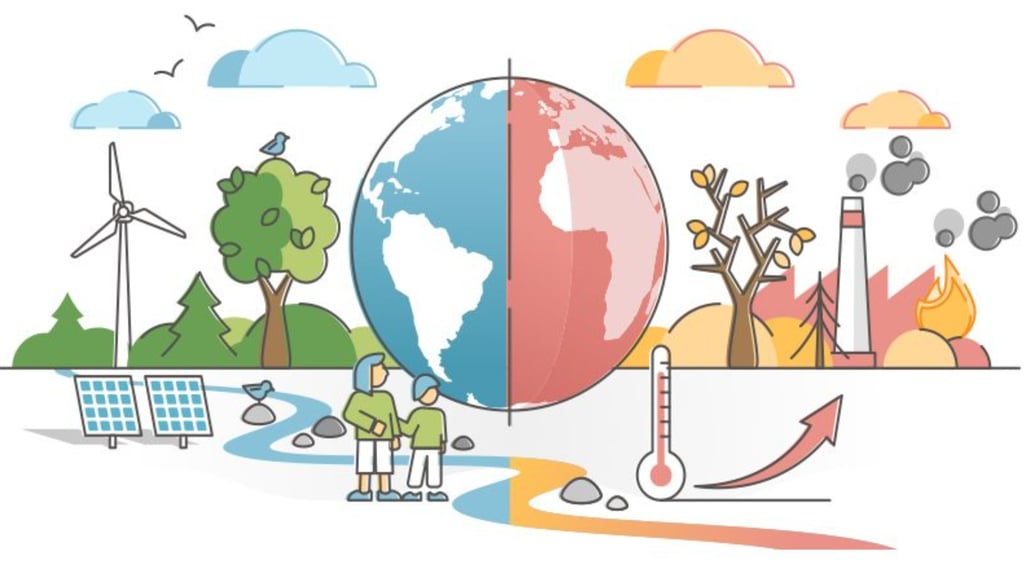
Credit: VectorMine/Shutterstock
Environmental governance includes policy, rules and norms that govern human behaviour, and it also addresses who makes decisions, how decisions are made and carried out, the scientific information needed for decision-making and how the public and major stakeholders can participate in the decision-making.
– United Nations Environment Programme
The Context and Foundations of Global Environmental Governance (1992-2000)
The period from 1992 to 2025 has been marked by profound transformations in geopolitical dynamics and a worsening of environmental problems. In response, the period has also witnessed significant efforts to strengthen international environmental governance and to develop global environmental and sustainable development policy frameworks. The period has also seen unprecedented increases in scientific assessments of environmental issues and in understanding how to solve the problems facing the planet. Understanding these historical, political, and institutional contexts is essential for assessing the effectiveness of the 2030 Agenda for Sustainable Development (3) and the Medium-Term Strategy (4) of the United Nations Environment Programme (UNEP). (5)
The 1990s marked a decisive turning point in international environmental governance, characterised by landmark conferences, the establishment of new legal instruments, such as the UN Framework Convention on ClimateChange (6), UN Convention on Biological Diversity (7), the UN Convention to CombatDesertification (8), the Rotterdam Convention on Prior Informed Consent (9), and a renewed acceleration in the consolidation of global environmental norms. During this decade, environmental considerations became inextricably linked to economic and social development objectives, establishing the foundations of contemporary sustainable development governance.
The most important event for advancing global norms was the United Nations Conference on Environment and Development (UNCED) (10), also known as the ‘Earth Summit,’ held in Rio de Janeiro in 1992. This summit was a watershed moment for global environmental policy.
The Earth Summit produced Agenda 21 (11), a comprehensive plan of action addressing environmental, economic, and social dimensions of development. Agenda 21 underscored the interconnections between poverty eradication, environmental protection, and economic growth, offering a blueprint for national and international policy formulation. Its adoption signalled a move away from isolated environmental efforts toward a coordinated, multi-sector approach that emphasises inclusive governance, the integration of environmental goals into development planning, and accountability across all levels of decision-making. For the first time, the framework recognised the rights and responsibilities of nine key stakeholder constituencies—referred to as the Major Groups: Women, Children and Youth, Indigenous Peoples, Non-Governmental Organisations, Local Authorities, Workers and Trade Unions, Business and Industry, the Scientific and Technological Community, and Farmers. This recognition marked a significant milestone in global environmental and sustainable development governance, ensuring that these groups had a formal role in international deliberations. Their inclusion extended beyond United Nations forums to other global platforms such as the G7 and G20, embedding participatory engagement as a cornerstone of multilateral environmental decision-making.
At the Earth Summit, countries adopted the Rio Declaration on Environment and Development (12), a set of 27 principles guiding sustainable development and environmental protection. In addition, they agreed on the Forestry Principles (13), a non-legally binding but authoritative global statement outlining shared commitments for the management, conservation, and sustainable development of all types of forests. In response to the need for oversight and monitoring of Agenda 21 implementation, the decision was made to establish the Commission on Sustainable Development, the CSD (14), on 22 December 1992, which was formally established through a resolution adopted on 29 January 1993.
During its initial phase, the Commission on Sustainable Development (CSD) not only reviewed selected chapters of Agenda 21 but also examined the connections between the climate and biodiversity conventions up to 1997. The CSD, during its 21 years, functioned as an innovative governance mechanism, bringing together Member States and Major Groups to ensure transparency and accountability. Although initially limited in its resources and operational capacity, the CSD introduced a model for multi-stakeholder engagement that informed subsequent structures within UNEP and other UN institutions. Its work emphasised the importance of integrating scientific data into policymaking and provided a platform for ongoing dialogue between governments and non-state actors, highlighting early lessons in participatory governance.
From 1997-2002, the first two days of the Commission of Sustainable Development held an interactive dialogue between stakeholders and member states before moving to negotiate the political outcomes. Its most successful dialogue was on tourism, where it was estimated that up to 70% of the negotiated outcome stemmed from ideas presented in the multistakeholder dialogue with member states.
The 1990s saw several UN interlinked conferences and summits that were focused on advancing global social and sustainable development agendas by addressing human rights, equity, and the social dimensions of sustainability that complemented the goals of Agenda 21 and the Rio Earth Summit, including:
- 1990 – The Children’s Summit
- 1993 – The World Conference on Human Rights
- 1995 – The World Summit for Social Development
- 1995 – The Fourth World Conference on Women
- 1996 – Habitat II (the Second United Nations Conference on Human Settlements
- 1996 – The World Food Summit
- 1997 – United Nations General Assembly Special Session, otherwise known as Rio+5
The early 1990s also witnessed the adoption of several landmark international agreements at the 1992 Earth Summit. These conventions laid the groundwork for coordinated global action on climate change, biodiversity loss, and sustainable development. The key agreements include:
- The United Nations Framework Convention on Climate Change (UNFCCC) (15) – Adopted at the 1992 Earth Summit and entering into force on March 21, 1994, the UNFCCC established a framework for international cooperation to combat climate change by stabilizing greenhouse gas concentrations in the atmosphere.
- Kyoto Protocol (16) – Adopted in 1997 as a protocol to the UNFCCC, it set legally binding emission reduction targets for developed countries, marking the first concrete step toward implementing the Convention’s objectives.
- Convention on Biological Diversity (CBD) (17) – Also adopted at the Earth Summit and entering into force on December 29, 1993, the CBD focuses on the conservation of biological diversity, the sustainable use of its components, and the fair and equitable sharing of benefits arising from genetic resources.
- The United Nations Convention to Combat Desertification (UNCCD) (18) – Adopted in 1994 and entering into force in 1996, the UNCCD aims to prevent and reverse land degradation and desertification, particularly in arid, semi-arid, and dry sub-humid areas, linking environmental sustainability with poverty reduction and sustainable land management.
- Rotterdam Convention on Prior Informed Consent (PIC) (19) – Adopted on 10 September 1998 and entering into force on 24 February 2004 after ratification by 50 countries, the convention establishes the Prior Informed Consent (PIC) procedure, enabling countries to make informed decisions about whether to accept the import of certain hazardous chemicals. This enhanced international cooperation and safety in chemical trade.
These agreements are highly significant in that they codified international commitments to climate mitigation and biodiversity conservation. These treaties introduced mechanisms for reporting, compliance, and policy integration into national planning. The conventions institutionalised the principles of precaution, sustainability, and equity, and set precedents for subsequent multilateral negotiations on climate, biodiversity, and chemical pollutants.
Central to making these commitments effective is the rule of law. While environmental law existed before UNEP, the organisation played a crucial role in transforming it into a coherent global framework. UNEP championed the idea that sound environmental policy must be grounded in scientific evidence and supported by legal norms and enforcement mechanisms. Laws without a foundation in environmental science or shared ethical standards lack both credibility and impact. UNEP’s work helped establish environmental jurisprudence as a discipline—one that provides the legal and moral backbone for implementing environmental governance worldwide.
When UNEP began its work in 1972, global and national systems of environmental law were still in their infancy. Over the decades, that landscape transformed dramatically. Environmental jurisprudence has since come to represent not only a legal framework but also a shift in global ethics—acknowledging that both individuals and governments bear responsibility for protecting the natural world. UNEP has been instrumental in this transformation through capacity building, fostering cooperation, and supporting countries in codifying environmental protection within their legal systems.
In 1980, UNEP’s Governing Council (20) took a decisive step forward by requesting a framework for the systematic development and review of environmental law (Decision 8/15, 29 April 1980). This led to the establishment of the Montevideo Environmental Law Programme (21), a landmark initiative that continues to guide international legal efforts. The Programme provides a platform for addressing emerging legal issues, strengthening environmental governance, and ensuring that the law keeps pace with scientific and policy advancements. Since its inception, each decade has seen the adoption of a new Montevideo Programme—now brought to the UN Environment Assembly (22), reflecting the ongoing evolution of global environmental law and UNEP’s enduring leadership in this field.
Despite increased environmental problems, ambitious frameworks, and efforts to translate international commitments into national and international action plans, this was often challenging. Many countries faced limited technical capacity to address environmental issues, inadequate funding, and competing political priorities, hindering effective implementation. UNEP navigated these challenges while reporting through ECOSOC, which sometimes affected the clarity and reach of its communications to the General Assembly. These circumstances reflected broader structural constraints in global environmental governance at the time, rather than the effectiveness or dedication of UNEP itself.
Consolidation, Expansion, and Emerging Crises (2000-2012)
During the 1990s, a series of international summits consistently highlighted poverty eradication as a top global priority. Outcome reports from these gatherings often summarised development priorities, but the environment was rarely included; for example, the Social Summit (23) defined 10 goals, none of which focused explicitly on environmental issues. Influential in shaping negotiators’ thinking was the OECD-DAC report Shaping the 21st Century – The Contribution of Development Cooperation, which identified environmental protection and sustainable development as critical areas for international attention.
In 2000, the Millennium Development Goals (MDGs) (24) were adopted, which reflected the mindset of the majority of the UN Member States for structural, measurable improvements to the quality of life of all people across the globe. The MGDs were a set of eight international development goals established by the UN following the Millennium Summit (25) in 2000. They were designed to address extreme poverty, social inequality, and environmental sustainability by 2015. The MGDs were built on decades of UN conferences and global development agreements, setting measurable targets to focus the efforts of governments, international organisations, and Major Groups and other stakeholders. The eight MDGs are:
- Eradicate extreme hunger and poverty;
- Achieve universal primary education;
- Promote gender equality and empower women;
- Reduce child mortality;
- Improve maternal health;
- Combat HIV/AIDS, malaria, and other diseases;
- Ensure environmental sustainability; and
- Develop a global partnership for development.
Between the Millennium Summit and the Rio+20 in 2012, serious efforts were made to consolidate and expand environmental and sustainable development governance. Several participants at the Earth Summit had felt that environmental concerns were made subordinate to developmental priorities, and since then, environmental concerns had increasingly intersected with economic development. Governance frameworks often reflected these priorities, as well as being forced to accommodate complex global challenges.
Following this, the Millennium Declaration (26), adopted by the UN General Assembly, mandated the UN to develop a set of global targets for the international community to achieve by 2015. Environmental considerations were explicitly integrated through Millennium Development Goal 7 (MDG7) (27), which aimed to ensure environmental sustainability. MGD7 had four targets:
- To integrate the principles of sustainable development into every nation’s policies and programmes, and reverse the depletion of environmental resources;
- To reduce biodiversity loss and achieve a substantial reduction in the rate of loss by 2010;
- To halve the proportion of the universal population without sustainable access to clean and safe drinking water and basic sanitation by 2015 (this target was not in the original set of targets but added by the World Summit in 2002);
- To achieve substantial improvement in the lives of a minimum of 100 million slum dwellers by 2020.
The World Summit in Sustainable Development (WSSD) in 2002, also known as ‘Rio+10’, expanded alongside the MGD7 to reinforce the environmental dimension of the MDGs. It was held in Johannesburg, South Africa (August 26 to September 4th) in the shadow of the 9/11 attacks on the World Trade Center in New York. It had four preparatory meetings, which then adopted three key outcomes:
- Plan of Implementation (28) – This document outlined actions and goals for achieving sustainable development.
- Political Declaration – This declaration reaffirmed commitments around the environment and sustainable development, and the importance of factors such as good governance and human rights.
- Partnerships and Initiatives – A major outcome was the creation of new partnerships to drive action on specific issues. In particular, it focused on the WEHAB framework: Water, Energy, Health, Agriculture, and Biodiversity. Partnerships and additional ones on consumption and production. As environmental problems increased over the years, there was an urgent need for continuous political decision-making to address them, and the Global Ministerial Environment Forum (GMEF) (29) was established, among others, to respond to this challenge. UNEP convened its 6th Special Session to inaugurate this new format, with the first GMEF held in Malmö, Sweden, in 2000.
- It added the target on sanitation to MDG 7.
TheStockholm Convention (30) on Persistent Organic Pollutants (POPs), adopted in 2001 and entering into force in 2004, grew out of years of UNEP’s scientific and policy work on chemicals and health, including the Governing Council decision 19/13C (1997). While not solely an outcome of MDG7 or the WSSD, the broader political momentum around sustainable development during this period reinforced support for its adoption.
During this period, UNEP’s organisational structure and mandate were increasingly scrutinised. Recognised as the ‘environmental conscience of the UN,’ UNEP’s status as an administrative programme limited its institutional leverage compared to that of specialised agencies. Reporting through ECOSOC often filtered or delayed key messages, and UNEP’s modest budget constrained its ability to implement comprehensive global programmes. Nevertheless, its headquarters in Nairobi enhanced the representation of the Global South in international environmental governance, providing a platform for regional leadership and enabling partnerships with African institutions. Operational challenges—including infrastructure limitations and regional political instability—required adaptive strategies and incremental capacity-building.
Since the establishment of UNEP in 1972, growing concern over hazardous chemicals and waste has contributed to the development of several foundational international agreements. The Stockholm Convention on Persistent Organic Pollutants (POPs) (31) seeks to eliminate or restrict the production and use of long-lasting toxic substances, while the Rotterdam Convention on Prior Informed Consent (PICs) (32) ensures transparency in the global trade of hazardous substances. To improve coordination, the “Super COP” was established in 2010 and held its first meeting in 2013, bringing together the Basel, Rotterdam, and Stockholm Conventions under one joint conference. This framework paved the way for the 2013 Minamata Convention on Mercury (33), which addresses mercury emissions and pollution. Together, these agreements form the core of the international chemicals and waste regime and reflect decades of UNEP’s work on environment and health, distinct from, though complementary to, the more recent framing of global environmental challenges.
This decade saw the acceleration of multiple environmental crises: deforestation, biodiversity loss, desertification, drought, and flooding, and the first observable impacts of climate change. Regional conflicts, climate-related disasters, and economic crises diverted attention and resources. This further complicated environmental governance, and UNEP’s monitoring, reporting, and advisory roles were critical in addressing these intersecting challenges, providing evidence-based guidance to national and international policymakers.
The early 2000s also marked the expansion of participatory governance mechanisms. UNEP’s Governing Council had adopted the concept and use of the nine Major Groups recognised for their role in sustainable development in 1996, and non-state actors began to engage more actively in UNEP consultations. This reflected the recognition that inclusive decision-making processes would enhance both legitimacy and effectiveness. Multi-stakeholder platforms facilitated knowledge sharing, integrated scientific expertise into policy, and fostered collaborative problem-solving.
Global Governance, Policy Challenges, and the 2030 Agenda (2012–2025 and Beyond)
From 2012 onward, geopolitical shifts, such as the rise of nationalism, populism, and protectionism, challenged multilateral institutions and agreements, while the impact of climate change, pollution and environmental destruction intensified globally. Consequently, global governance issues became increasingly complex. Rising greenhouse gas concentrations, extreme weather events, biodiversity loss, marine pollution, and land degradation highlighted the urgent need for cross-sectoral governance strategies. UNEP’s role in translating scientific knowledge into actionable policy became increasingly vital.
Held in 2012, the United Nations Conference on Sustainable Development, commonly known as Rio+20 (34), marked a pivotal moment in the evolution of global environmental governance. Centred on two key themes—the green economy in the context of sustainable development and poverty eradication, and the development of the institutional framework for sustainable development—the conference reignited international commitment to integrating environmental and development objectives. The conference at Rio+20 resulted in the outcome document The Future We Want (35), which called for strengthened global institutions and new mechanisms for coordination and accountability. The Rio+20 outcomes led directly to the creation of the High-level Political Forum on Sustainable Development (HLPF) (36), which in 2013 replaced the Commission on Sustainable Development as the central UN platform for reviewing progress toward sustainable development. It also paved the way for the establishment of the United Nations Environment Assembly (UNEA) (37), granting UNEP universal membership and an enhanced mandate. Most importantly, Rio+20 initiated and agreed to establish the process that culminated in the formulation of the Sustainable Development Goals (SDGs) (38)—a unified framework that now guides global action toward an integrated vision of economic, social, and environmental sustainability, and is universal: it applies to all countries.
The SDGs became one of the central elements in the plan of action named: “Transforming our world: the 2030 Agenda for Sustainable Development.” This document, also known as the ‘2030 Agenda,’ (39) was adopted unanimously by the UN General Assembly in 2015.
Although all the 17 Goals reflect the three dimensions of sustainable development, they can be grouped in three clusters, with the ‘environmental’ Goals as the foundation (representing the limits of the planet), the ‘economic’ Goals as the means or enablers, and the ‘social’ Goals as the ultimate end. This is reflected in a well-known graph – the ‘wedding cake’ – originally published by the Stockholm Environment Institute, which has the economic Goals at the top. The Dutch Environmental Assessment Agency PBL revised this by putting the economy in the middle (i.e. not as an end but as a means). (PBL 2018). The two Goals focusing on governance and other means of implementation (16 and 17) support all the other Goals.
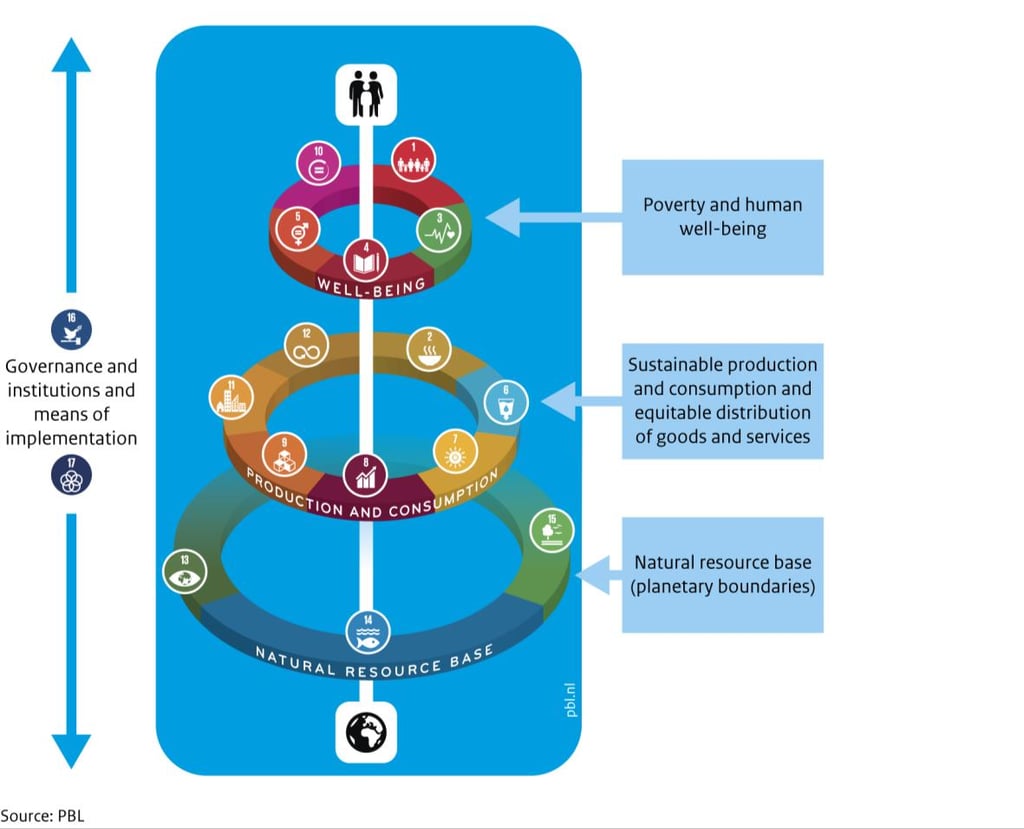
Source: Adapted from PBL (2017) and Lucas et al. (2016) (40)
Since 2015, global governance has been increasingly tested by competing political agendas, shifting alliances, and fractured international coordination. Trade disputes, regional tensions, and uneven institutional capacities have complicated collective responses to environmental challenges. These dynamics highlight the vulnerability of current governance systems and emphasise the need for resilient institutions that can manage complex interactions between environmental imperatives and political realities.
The impacts of climate change intensified rather than abated, with record greenhouse gas concentrations, extreme weather events, and ecosystem disruptions. Created by UNEP and the World Meteorological Organisation (WMO) (41) in 1988, the Intergovernmental Panel on Climate Change (IPCC) (42) was endorsed by the UN GA in the same year. IPCC currently has 195 Member countries with several thousand scientists from around the world, producing the most reliable reports on climate issues: the Assessment Reports. The IPCC Sixth Assessment Report (43) highlighted that cumulative climate impacts were already affecting food security, water availability, and urban resilience. Concurrently, biodiversity loss, marine pollution, and land degradation emerged as critical systemic challenges, demanding comprehensive, cross-sectoral governance strategies. UNEP’s advisory role became increasingly crucial in translating scientific knowledge into actionable policy recommendations.
The 2030 Agenda for Sustainable Development, which includes the Sustainable Development Goals (SDGs) (44), represents a universal framework designed to guide global action on poverty eradication, environmental protection, and inclusive economic growth. Building on the lessons of the Millennium Development Goals (MDGs), the SDGs expanded the scope of global development priorities from 8 to 17 goals, reflecting a more holistic understanding of the interconnected nature of social, economic, and environmental challenges. The goals integrate climate action, biodiversity conservation, and sustainable resource management alongside objectives for equality, health, education, and governance. Their development was marked by an unprecedented participatory process involving governments, stakeholders, including the nine Major Groups, academia, and the private sector, emphasising inclusivity, universality, and accountability. As a result, the SDGs established not only a shared vision for sustainable development but also a renewed commitment to aligning national and international policies with long-term environmental and social well-being.
Although the High-level Political Forum has been charged with a key responsibility for monitoring the implementation of the 17 SDGs, all UN entities are involved in implementing the SDGs. As the SDGs are universal in nature, UN member states have also adopted national strategies based on the SDGs.
A clear distinction between policy and governance became central to discussions on SDG implementation. Whereas policy articulates goals and strategies, governance establishes mechanisms to ensure effective execution, monitoring, and accountability. Effective governance structures are essential for translating SDG commitments into measurable outcomes, particularly in a complex global environment characterised by political fragmentation, resource inequality, and competing development priorities. UNEP’s evolving approach emphasises evidence-based policymaking, transparency, and participatory governance as critical tools for implementation.
UNEP was given definite tasks by the Rio+20 Summit, among other issues related to sustainable consumption and production. UNEP’s evolving approach regarding the 2030 Agenda and solving environmental problems has emphasised evidence-based policymaking, transparency, and participatory governance as critical tools for implementation. Commemorating UNEP’s 50th anniversary in 2022, the UN Environment Assembly decided on a Political Declaration strongly emphasising the necessity of strong environmental governance tools, pointing to the legacy of UNEP’s fifty year work within this realm and its unique position as the world’s leading environmental authority, ideas that have been reflected in the work now being carried out under the mantle of the United Nation’s 80th anniversary (UN80).
The United Nations’ 80th anniversary in 2025 offered an opportunity to reflect on achievements and ongoing institutional challenges. The UN 80 (45) commemoration highlighted the importance of multilateralism, institutional reform, and strengthening UNEP as a central actor in global environmental governance. These reflections have informed discussions about improving the efficiency, reach, and inclusiveness of international environmental governance, while emphasising the need for adaptive strategies in the face of evolving global challenges.
Building on UN80’s reflections, UNEP’s flagship Outlook Report has watched the horizon of environmental change since 1995, alerting us to how our actions influence our planet. The Global Environmental Outlook (GEO) (46) is a series of reports that review the state and direction of the global environment. It is a global process spearheaded by UNEP at the regional, national, and local levels all over the world. The process provides an assessment of the current state of the environment, an evaluation of the effectiveness of policies and actions taken to address environmental issues, and projections of future environmental trends.
UNEP’s GEO reports try to provide an independent assessment of the state of the global environment and how trends and policies affect it. The GEOs aim to bridge the gap between science and policy and have a key purpose to inform decision-makers about environmental challenges, evaluate policy responses, and project probable future environmental trends and solutions to guide long-term planning.
The UN family produces a set of fact-based reports on the state of the environment, climate issues, pollution, and, of course, the implementation of the SDGs. Each of the three science-policy bodies: the IPCC on climate, the IPBES on biodiversity, and the latest, which was established by UNEP in June 2025, the Intergovernmental Science-Policy Panel on Chemicals, Waste and Pollution (ISP-CWP) (47), all provide fact-based reports.
The Global Sustainable Development Reports (GSDRs) (48) provide evidence-based assessments of progress toward the SDGs and illuminate persistent systemic challenges. The Global Sustainable Development Report 2019 (49) and the Global Sustainable Development Report 2023 (50) are issued every four years, providing key science-policy insights into progress on the Sustainable Development Goals. The upcoming edition will be published in 2027.
The GSDRs have so far consistently identified climate change, inequality, unsustainable consumption, and governance weaknesses as significant obstacles. Regional disparities, resource constraints, and limited institutional capacity exacerbate these challenges, particularly in low-income countries. These findings of all these reports underscore the critical need for strengthened governance frameworks that integrate science, policy, and stakeholder input to achieve sustainable development objectives.
The reports emphasise integrated approaches recognising the interconnections among environmental, social, and economic dimensions. They advocate for inclusive governance mechanisms, engagement with Major Groups and other stakeholders, indigenous knowledge systems, and the systematic incorporation of scientific expertise into policymaking. UNEP’s role as a coordinating hub underscores the need for institutional capacity, transparency, and multi-level stakeholder engagement to drive transformative change.
Outlining and summarising in broad strokes the global challenges facing humanity, Executive Director of UNEP, Ms Inger Andersen, addressed the Committee of Permanent Representatives (CPR), a subsidiary body to the UN and the governing body of UNEP, in the midst of the global Coronavirus pandemic that had paralysed the world. Speaking virtually, on 14 July 2020 to the CPR, she identified issues that should be at the core of the Medium-Term Strategy for UNEP during 2022-2025. She said the world was facing a global crisis of historic proportions, which she called the Triple Planetary Crisis of climate, nature, and pollution. Whereas the issues of climate, nature, and pollution might have been obvious to discuss, this demonstrates the unique position that UNEP embodies within the UN family – the mandate and ability to combine and synthesise relevant issues to be addressed holistically. Based on solid science and with appropriate governance tools, the nexus themes of the Triple Planetary Crisis soon engaged all UN entities working on environment-related issues and propelled UNEP to a leading position in alerting decision-makers across all segments of society to the interconnectedness of environmental problems. The Triple Planetary Crisis became the way to identify global environmental challenges, analyse issues, and identify solutions for the future.
References
3 United Nations. Transforming Our World: The 2030 Agenda for Sustainable Development. 2015. https://sdgs.un.org/2030agenda
4 United Nations Environment Programme. Medium-Term Strategy, Committee of Permanent Representatives (170th Meeting). https://wedocs.unep.org/bitstream/handle/20.500.11822/47626/170thCPR_MTS.pdf
5 United Nations Environment Programme. UNEP. https://www.unep.org/
6 United Nations Framework Convention on Climate Change. UNFCCC. https://unfccc.int/
7 Convention on Biological Diversity. Convention on Biological Diversity. 1992. https://www.cbd.int/
8 United Nations Convention to Combat Desertification. UNCCD. 1994. https://www.unccd.int/
9 Rotterdam Convention. Rotterdam Convention on the Prior Informed Consent Procedure. 1998. https://www.pic.int/
10 United Nations. United Nations Conference on Environment and Development (Rio Earth Summit). 1992. https://www.un.org/en/conferences/environment/rio1992
11 United Nations. Agenda 21. 1992. https://sdgs.un.org/publications/agenda21
12 United Nations. Rio Declaration on Environment and Development. 1992. https://www.un.org/en/development/desa/population/migration/generalassembly/docs/globalcompact/A_CONF.151_26_Vol.I_Declaration.pdf
13 United Nations. United Nations Forest Instrument. 2007. https://www.un.org/esa/forests/wp-content/uploads/2018/08/UN_Forest_Instrument.pdf
14 United Nations. Commission on Sustainable Development. https://www.un.org/esa/dsd/csd/csd_aboucsd.shtml
15 United Nations Framework Convention on Climate Change. UNFCCC. https://unfccc.int/
16 United Nations. Kyoto Protocol. 1997. https://unfccc.int/process-and-meetings/the-kyoto-protocol
17 Convention on Biological Diversity. Convention on Biological Diversity (Text). 1992. https://www.cbd.int/doc/legal/cbd-en.pdf?utm
18 United Nations Convention to Combat Desertification. UNCCD. 1994. https://www.unccd.int/
19 Rotterdam Convention. Rotterdam Convention. 1998. https://www.pic.int/
20 United Nations. UNEP Governing Council. https://www.un.org/en/desa/unep-governing-council
21 United Nations Environment Programme. Promoting Environmental Rule of Law. https://www.unep.org/explore-topics/environmental-rights-and-governance/what-we-do/promoting-environmental-rule-law-1
22 United Nations Environment Programme. UN Environment Assembly. https://www.unep.org/environmentassembly/
23 United Nations Department of Economic and Social Affairs. World Summit for Social Development 2025. https://social.desa.un.org/world-summit-2025
24 United Nations. Millennium Development Goals. 2000. https://www.un.org/millenniumgoals/?utm
25 United Nations. Millennium Summit. 2000. https://www.un.org/en/conferences/environment/newyork2000
26 Office of the United Nations High Commissioner for Human Rights. United Nations Millennium Declaration. 2000. https://www.ohchr.org/en/instruments-mechanisms/instruments/united-nations-millennium-declaration
27 MDG Monitor. MDG 7: Ensure Environmental Sustainability. https://www.mdgmonitor.org/mdg-7-ensure-environmental-sustainability/
28 United Nations. World Summit on Sustainable Development Plan of Implementation. 2002. https://www.un.org/esa/sustdev/documents/WSSD_POI_PD/English/WSSD_PlanImpl.pdf
29 United Nations. Global Ministerial Environment Forum. https://www.un.org/en/desa/global-ministerial-environment-forum
30 Stockholm Convention. Stockholm Convention on Persistent Organic Pollutants. 2001. https://www.pops.int/
31 United Nations. Stockholm Convention Treaty Information. 2001. https://treaties.un.org/pages/ViewDetails.aspx?src=TREATY&mtdsg_no=XXVII-15&chapter=27
32 United Nations. Rotterdam Convention Treaty Information. 1998. https://treaties.un.org/pages/ViewDetails.aspx?src=TREATY&mtdsg_no=XXVII-14&chapter=27
33 United Nations Environment Programme. Minamata Convention on Mercury. 2013. https://www.unep.org/globalmercurypartnership/resources/policy-and-strategy/minamata-convention-mercury
34 United Nations. Rio+20 Conference on Sustainable Development. 2012. https://sustainabledevelopment.un.org/rio20
35 United Nations. The Future We Want. 2012. https://sustainabledevelopment.un.org/futurewewant.html
36 United Nations. High-Level Political Forum on Sustainable Development. https://hlpf.un.org/
37 United Nations Environment Programme. UN Environment Assembly. https://www.unep.org/environmentassembly/
38 United Nations. Sustainable Development Goals. https://sdgs.un.org/
39 United Nations. 2030 Agenda for Sustainable Development. 2015. https://sdgs.un.org/2030agenda
40 PBL Netherlands Environmental Assessment Agency. Using Planetary Boundaries to Support National Implementation of Environment-Related Sustainable Development Goals. 2019. https://www.pbl.nl/en/publications/using-planetary-boundaries-to-support-national-implementation-of-environment-related-sustainable-development-goals
41 World Meteorological Organization. WMO. https://wmo.int/
42 Intergovernmental Panel on Climate Change. IPCC. https://www.ipcc.ch/
43 Intergovernmental Panel on Climate Change. Sixth Assessment Report (AR6). 2021–2023. https://www.ipcc.ch/assessment-report/ar6/
44 United Nations. Sustainable Development Goals. https://sdgs.un.org/goals
45 United Nations. UN80 Initiative. https://www.un.org/en/un80
46 United Nations Environment Programme. Global Environment Outlook. https://www.unep.org/resources/global-environment-outlook
47 United Nations Environment Programme. Integrated Sustainable Cities Programme (ISC-CWP). https://www.unep.org/isp-cwp
48 United Nations. Global Sustainable Development Report. https://sdgs.un.org/gsdr?utm
49 United Nations. Global Sustainable Development Report 2019. 2019. https://sustainabledevelopment.un.org/content/documents/24797GSDR_report_2019.pdf
50 United Nations. Global Sustainable Development Report 2023. 2023. https://sdgs.un.org/gsdr/gsdr2023
Graphic – PBL Planbur. Voor Leefomgeving. URL https://www.pbl.nl/en/publications/using-planetary-boundaries-to-support-national-implementation-of-environment-related-sustainable-development-goals (accessed 9.6.20).