
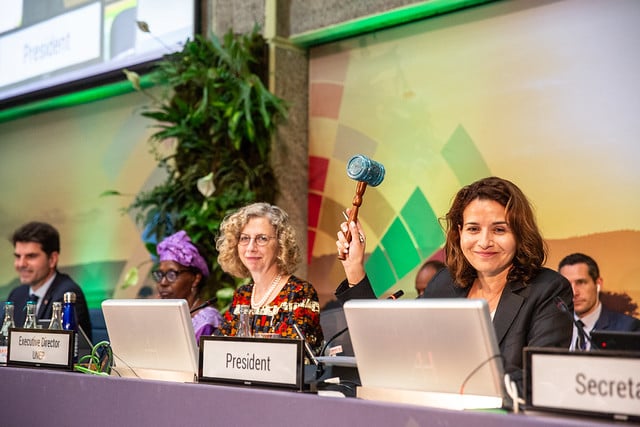
Closing Plenary of the sixth session of UN Environment Assembly (UNEA-6). Source: https://www.unep.org/environmental-moments-unep50-timeline (51)
The United Nations Environment Programme (UNEP) (52) is the leading global authority on the environment within the United Nations system, responsible for setting the environmental agenda and supporting countries in addressing ecological challenges. While its work contributes to sustainable development, UNEP’s mandate focuses specifically on the environmental dimension of sustainable development rather than the full scope of the 2030 Agenda.
Established following the 1972 United Nations Conference on the Human Environment (53) in Stockholm, Sweden (the first global gathering devoted entirely to environmental issues), UNEP was created by the General Assembly to serve as the UN system’s environmental conscience and scientific centre. Since then, its mandate has been periodically reaffirmed and strengthened through successive Governing Council and General Assembly decisions, consistently emphasising its role in environmental protection, coordination, and policy guidance. Over time, UNEP has evolved to address emerging challenges, and today its mission is often framed through the lens of the Triple Planetary Crisis of climate change, biodiversity loss, and pollution, reflecting on the interconnected environmental pressures shaping global policy and international cooperation.
Headquartered in Nairobi, Kenya, UNEP (alongside UN-Habitat) stands as one of the leading UN entities based in the Global South. This location reflects a deliberate commitment to inclusivity and the integration of developing countries into the centre of decision-making. Over the decades, UNEP has continually expanded its scope to address emerging and interlinked challenges such as climate change, biodiversity loss, pollution, and the transition to a circular economy. Its evolution demonstrates both institutional resilience and an enduring capacity to adapt to the shifting demands of global governance.
When UNEP was first created, it was overseen by a Governing Council, which was set up by a United Nations decision (General Assembly Resolution 2997) on 15 December 1972. The Governing Council reported its progress to the United Nations General Assembly, which acts as the main decision-making body of the UN, the Economic and Social Council (ECOSOC), a UN Charter body and one of the six main organs of the UN. ECOSOC oversees global issues related to development, health, and the environment and members of the Council are chosen by the General Assembly for four-year terms, following the principle of equitable regional representation to ensure global balance and inclusivity.
The Governing Council was tasked with promoting international cooperation on environmental matters and providing overarching policy guidance for the coordination of environmental activities across the United Nations system. In 1999, the General Assembly further strengthened UNEP’s institutional framework by establishing the Global Ministerial Environment Forum (GMEF) (54). The GMEF convened environment ministers from across the world to deliberate on emerging and significant global environmental policy issues, reinforcing UNEP’s role as the central convening authority for environmental governance within the UN system.
The UN’s primary budget is funded by mandatory assessed contributions from 193 Member States, with each country’s share determined by its capacity to pay. This includes contributions to UNEP, though their work is financed primarily through voluntary contributions from Member States, supplemented by earmarked project funding. This reliance on voluntary finance has been a persistent institutional challenge, occasionally leading to disproportionate influence from industrialised donors and uneven regional representation in programme priorities. Nevertheless, UNEP continues to serve as the anchor institution of the global environmental system, coordinating with other UN entities, regional bodies, and stakeholder partners to advance multilateral environmental agreements and environmental governance reform. Although UNEP has developed several well-regarded on-the-ground partnerships, its operational capacity remains significantly limited compared to that of its sister agency, the United Nations Development Programme (UNDP), which maintains an extensive country-level presence. Stakeholders widely recognise UNDP’s critical role in supporting countries as they navigate international environmental governance frameworks and implement multilateral environmental agreements, particularly through equitable access to technical guidance, capacity-building, and practical planning resources.
Furthermore, UNEP lacks the authority to enforce global environmental legislation or to direct environmental strategy across the broader UN system, as its mandate is primarily facilitative and advisory rather than regulatory, leaving it dependent on voluntary cooperation from Member States and other UN agencies to implement its recommendations. Continued and strengthened cooperation between UNEP, UNDP, governments, and stakeholders can improve institutional coherence, reduce fragmentation, and support more evidence-informed and effective environmental governance. It can also help accelerate implementation through joint multi-stakeholder partnerships.
Efforts to strengthen UNEP’s authority have been a recurrent theme in international environmental diplomacy. Over the years, proposals ranged from transforming UNEP into a specialised agency to enhancing its coordination role within a broader international environmental governance architecture. The 2012 UN Conference on Sustainable Development (Rio+20) formally decided to establish the UN Environment Assembly (UNEA) in 2013, as UNEP’s new universal governing body. The final session of the former Governing Council, also functioning as a Global Ministerial Environment Forum (GMEF), was held in 2013, paving the way for the inaugural UNEA in 2014. With this transition, all 193 UN Member States gained equal participation and decision-making power in shaping global environmental policy, replacing the more limited membership structure of the Governing Council.
Nevertheless, UNEP has achieved notable success in developing and managing international frameworks to address global environmental challenges. The organisation has played a pivotal role in advancing global efforts to regulate toxic pollutants and chemicals, protect the ozone layer, and combat biodiversity loss and climate change. Several landmark agreements and conventions designed to confront these issues were conceived and initiated under UNEP’s leadership.
Medium-Term Strategy 2026–2029
The Medium-Term Strategy (MTS) defines UNEP’s vision, strategic direction, and operational priorities over a four-year period, translating global environmental commitments into a coherent framework for action that supports the 2030 Agenda for Sustainable Development.
The UNEP Medium-Term Strategy 2026–2029, ‘the Strategy,’ (55) is the organisation’s main roadmap for how it plans to help tackle the world’s three interconnected environmental crises: climate change, loss of nature and land, and pollution. Developed under decision UNEP/EA.6/L.3, the Medium-Term Strategy (along with its related Programme of Work and Budget for 2026-2027) was created through a collaborative process that included input from Member States, stakeholder groups, and UNEP’s Committee of Permanent Representatives (CPR). The completed Strategy is scheduled to be presented for approval at the Seventh Session of the UN Environmental Assembly (UNEA7) (56) in December 2025.
The MTS 2026–2029 articulates a vision of “healthy, prosperous and resilient people and planet”. It builds on the foundations of the 2022–2025 Strategy, reaffirming three overarching objectives: Climate Stability, Living in Harmony with Nature, and Towards a Pollution-Free Planet. These objectives are supported by six thematic sub-programmes—Climate Action, Nature Action, Chemicals and Pollution Action, Science-Policy, Environmental Governance, and Finance and Economic Transformations, as described below:
- Climate Action – Supports countries in achieving the goals of the Paris Agreement by advancing both mitigation and adaptation measures. It promotes pathways to net-zero emissions through renewable energy deployment, energy efficiency, and low-carbon development strategies. Climate Action also strengthens national adaptation planning, supports climate-resilient infrastructure, and integrates nature-based solutions to enhance community resilience and reduce vulnerability to climate impacts.
- Nature Action – Works to halt and reverse biodiversity loss by restoring ecosystems, conserving natural habitats, and promoting sustainable management of land, oceans, and freshwater resources. The sub-programme advances implementation of the Kunming-Montreal Global Biodiversity Framework (57) and encourages approaches that link ecosystem health with climate stability, food security, and human well-being. It also promotes community-led conservation and equitable benefit-sharing from natural resources.
- Chemicals and Pollution Action – Addresses pollution in all its forms—air, water, soil, and waste—by supporting the sound management of chemicals and the transition to a circular economy. It assists countries in meeting their obligations under global environmental agreements such as the Stockholm, Basel, and Minamata Conventions. Chemicals and Pollution Action also focuses on emerging challenges, including plastic pollution and hazardous waste, promoting cleaner production and waste prevention to safeguard health and ecosystems.
- Science-Policy – Strengthens the evidence base for environmental decision-making by providing authoritative assessments, open data, and scientific foresight. It supports global initiatives such as the Global Environment Outlook and enhances policymakers’ capacity to apply science-based approaches to governance and planning. The sub-programme promotes collaboration between scientists, policymakers, and stakeholders to ensure that environmental action is informed by the best available knowledge.
- Environmental Governance – Enhances institutional, legal, and participatory frameworks for effective environmental management. It supports countries in drafting, implementing, and enforcing environmental laws and policies while promoting multilateral cooperation and stakeholder engagement. Environmental Governance also emphasises transparency, access to information, and environmental justice, ensuring that decision-making processes uphold equity, accountability, and the rule of law at all levels.
- Finance and Economic Transformations – Seeks to realign financial systems and economic policies with environmental sustainability. It engages governments, businesses, and financial institutions to integrate environmental considerations into fiscal policy, investment decisions, and trade frameworks. The sub-programme promotes green finance, sustainable consumption and production, and inclusive economic models that drive a just transition toward low-carbon and resource-efficient economies.
The Strategy emphasises integration and coherence, ensuring that UNEP’s interventions are mutually reinforced across thematic and geographic areas. It promotes science-based policy, the use of environmental data for decision-making, and enhanced coordination among multilateral environmental agreements (MEAs). It also strengthens UNEP’s role as a knowledge broker and convenor, working across the UN system and with governments, and stakeholders, including the private sector, the private sector to deliver collective impact.
A central innovation of the 2026–2029 MTS is its strengthened results framework. The Strategy introduces measurable performance indicators and monitoring tools linked to UNEP’s Programme of Work, facilitating transparent evaluation of progress and alignment with the Sustainable Development Goals (SDGs). It also embeds cross-cutting commitments to gender equality, youth engagement, Indigenous knowledge systems, and “leaving no one behind,” ensuring that environmental action advances both equity and resilience.
Finally, the Strategy recognises the importance of inclusivity and shared ownership. Its development has involved extensive consultation with Member States and non-state actors, reflecting UNEP’s commitment to open and participatory governance. Through the MTS, UNEP seeks not only to accelerate action on the Triple Planetary Crisis, but to deepen the integration of environmental sustainability into the core of global development planning—an evolution consistent with its role as the environmental conscience of the United Nations.
UNEP Leadership, Structure, and the Divisions of UNEP
UNEP is led by an Executive Director and organised through a decentralised structure of six thematic divisions—Policy and Programme, Science, Ecosystems, Economy, Law, and Communication—that together coordinate global efforts to advance environmental sustainability and effective policy implementation. Each division is tasked with implementing specific components of UNEP’s Programme of Work, facilitating collaboration across global, regional, and national levels (see Chapter 6 for a detailed discussion of UNEP’s leadership, governance bodies, and institutional structure).
- Policy and Programme Division – Oversees UNEP’s strategic direction by coordinating its global Programme of Work and Medium-Term Strategy, ensuring that all activities align with UN priorities, the Sustainable Development Goals (SDGs), and results-based management practices.
- Science Division – Acts as UNEP’s scientific core, delivering reliable data, assessments, and analysis to guide sound environmental decision-making and bridge the gap between science and policy.
- Ecosystems Division – Works to protect, restore, and sustainably manage ecosystems across land, freshwater, and oceans, advancing biodiversity goals and promoting nature-based solutions that strengthen climate resilience and human well-being.
- Economy Division – Drives the shift toward greener and more inclusive economies by supporting sustainable production, circular economy approaches, and financial systems that link economic growth with environmental sustainability.
- Law Division – Provides expertise in environmental law and governance, helping countries craft and enforce legislation, strengthen institutions, and uphold international environmental commitments and justice.
- Communication Division – Leads UNEP’s global communications, campaigns, and outreach to raise awareness, mobilise action, and make environmental science and policy accessible to people and institutions worldwide.
UNEP’s regional offices—in Africa (58), Asia and the Pacific (59), Europe (60), Latin America and the Caribbean (61), North America (62), and West Asia (63)—act as key channels for engagement with Member States and regional institutions. This regional architecture enhances responsiveness to local environmental challenges while ensuring coherence with global priorities set by the UN Environment Assembly.
UNEP Civil Society Unit (Major Groups and Stakeholders) Engagement
Through the UNEP Civil Society Unit (64) (the Unit), UNEP facilitates structured engagement with civil society organisations and the nine Major Groups, which were identified in Agenda 21 as specific stakeholder categories recognised by UNEA. These nine Major Groups are Non-Governmental Organizations (65), Women (66), Children and Youth (67), Indigenous Peoples (68), Local Authorities (69), Farmers (70), Scientific and Technological Community (71), Workers and Trade Unions (72), and Business and Industry (73). Each Major Group has two representatives, resulting in a total of 18 members on the Major Groups Facilitating Committee (MGFP). The MGFC is further supported by two elected from each of UNEP’s six regions.
In addition to these nine Major Groups, other stakeholder categories, Persons with Disabilities (74), Volunteers (75), Ageing (76), and Education and Academia (77), engage specifically through the High-level Political Forum (HLPF) and do not participate directly in UNEP’s Major Groups framework.
The Unit plays a vital role in fostering transparency, inclusivity, and accountability within UNEP’s governance processes. It coordinates accreditation for stakeholder participation in UNEA and its subsidiary meetings, provides capacity-building and information-sharing platforms, and ensures that stakeholder perspectives inform UNEP’s policy formulation and implementation.
By integrating non-state actors into decision-making, UNEP recognises that environmental solutions must be co-created with those most affected by ecological degradation and those with the capacity to drive change at community and industry levels. The Civil Society Unit also administers the Major Groups Facilitating Committee (MGFC) (78), which serves as a formal consultative body representing stakeholder constituencies.
Major Groups Facilitating Committee
The Major Groups Facilitating Committee (MGFC) (79) was created to enhance communication and collaboration between the nine Major Groups identified in Agenda 21 and UNEP’s governing bodies. Comprised of elected representatives from each Major Group, the MGFC serves as a bridge to coordinate consultations, share information, and support collective advocacy on priority environmental policy issues. It helps ensure that the voices of diverse stakeholders are effectively represented in UNEP’s decision-making processes.
The MGFC provides structured input into UNEA resolutions, policy statements, and multi-stakeholder dialogues. It plays a key role in bringing grassroots perspectives to global discussions, identifying emerging environmental issues, and strengthening the inclusiveness and transparency of UNEP’s processes. By formalising stakeholder representation, UNEP has created a mechanism for meaningful participation by non-state actors in environmental governance.
Through regular meetings, digital consultations, and regional coordination, the MGFC exemplifies a participatory model of multilateral environmental governance. It reflects UNEP’s commitment to inclusive engagement as a cornerstone for building public trust and supporting the transformational objectives outlined in the Medium-Term Strategy and the 2030 Agenda for Sustainable Development.
References
51 United Nations Environment Programme. Environmental Moments: UNEP@50 Timeline. https://www.unep.org/environmental-moments-unep50-timeline
52 Browser Bookmark. Local Bookmark Reference. bookmark://_9ghy6ngh9nu8/
53 United Nations. United Nations Conference on the Human Environment (Stockholm Conference). 1972.https://www.un.org/en/conferences/environment/stockholm1972
54 United Nations. Global Ministerial Environment Forum.https://www.un.org/en/desa/global-ministerial-environment-forum
55 United Nations Environment Programme. Medium-Term Strategy, Committee of Permanent Representatives (170th Meeting).https://wedocs.unep.org/bitstream/handle/20.500.11822/47626/170thCPR_MTS.pdf?utm_
56 United Nations Environment Programme. Seventh Session of the UN Environment Assembly (UNEA-7).https://www.unep.org/environmentassembly/unea7
57 Convention on Biological Diversity. Kunming–Montreal Global Biodiversity Framework. 2022.https://www.cbd.int/gbf
58 United Nations Environment Programme. UN Environment Programme Africa Office.https://www.unep.org/regions/africa/our-work-africa/un-environments-africa-office
59 United Nations Environment Programme. Asia and the Pacific Region.https://www.unep.org/regions/asia-and-pacific
60 United Nations Environment Programme. Europe Region.https://www.unep.org/regions/europe
61 United Nations Environment Programme. Latin America and the Caribbean Region.https://www.unep.org/regions/latin-america-and-caribbean
62 United Nations Environment Programme. North America Region.https://www.unep.org/regions/north-america
63 United Nations Environment Programme. West Asia Region.https://www.unep.org/regions/west-asia
64 United Nations Environment Programme. Civil Society Unit.https://www.unep.org/civil-society-engagement/why-civil-society-matters/civil-society-unit
65 United Nations. Major Groups: Non-Governmental Organizations.https://sustainabledevelopment.un.org/majorgroups/ngos
66 United Nations. Major Groups: Women.https://sustainabledevelopment.un.org/majorgroups/women
67 United Nations. Major Groups: Children and Youth.https://sustainabledevelopment.un.org/majorgroups/childrenandyouth
68 United Nations. Major Groups: Indigenous Peoples.https://sustainabledevelopment.un.org/majorgroups/indigenouspeoples
69 United Nations. Major Groups: Local Authorities.https://sustainabledevelopment.un.org/majorgroups/localauthorities
70 United Nations. Major Groups: Farmers.https://sustainabledevelopment.un.org/majorgroups/farmers
71 United Nations. Major Groups: Scientific and Technological Community.https://sustainabledevelopment.un.org/majorgroups/scitechcommunity
72 United Nations. Major Groups: Workers and Trade Unions.https://sustainabledevelopment.un.org/majorgroups/workersandtradeunions
73 United Nations. Major Groups: Business and Industry.https://sustainabledevelopment.un.org/majorgroups/businessandindustry
74 United Nations. Major Groups: Persons with Disabilities.https://sustainabledevelopment.un.org/majorgroups/personswithdisabilities
75 United Nations. Major Groups: Volunteers.https://sustainabledevelopment.un.org/majorgroups/volunteers
76 United Nations. Major Groups: Ageing.https://sustainabledevelopment.un.org/majorgroups/ageing
77 United Nations. Major Groups: Education and Academia. https://sustainabledevelopment.un.org/majorgroups/educationandacademia
78 & 79 United Nations Environment Programme. Major Groups Facilitating Committee.https://www.unep.org/civil-society-engagement/major-groups-modalities/major-groups-facilitating-committee-mgfc