
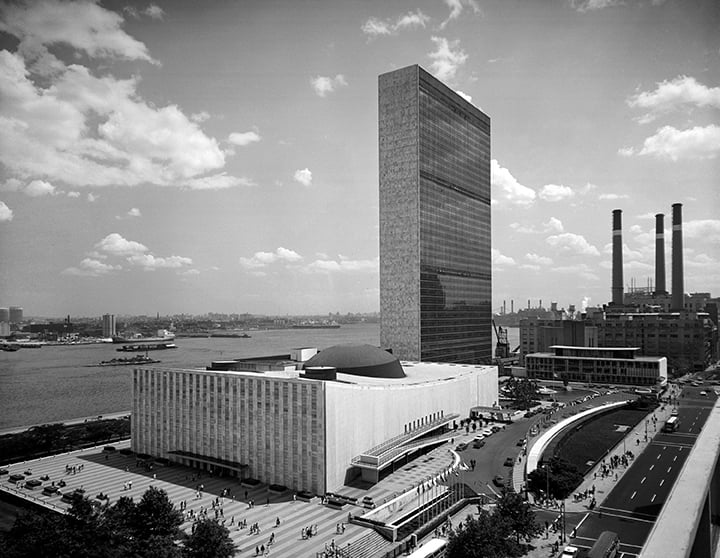
UN Headquarters in New York, circa 1968 (2) – Credit: UN Photo/Yutaka Nagata
Timeline
Key Milestones Since 1992
The following timeline outlines major global processes that have, over the past three decades, shaped government processes and systems as they relate to the environment and sustainable development.
1992 – UN Conference on Environment and Development (the Rio Earth Summit)
- Establishes three legally binding environmental conventions (CBD, UNFCCC, UNCCD).
- Establishes global processes that have, over the past three decades, shaped governance processes and systems as these relate to the environment and sustainable development.
- Issues recommendations on strengthening the institutional framework for the environment and sustainable development (Chapters 38 and 39 of Agenda 21).
- Gives UNEP a new and expanded mandate to work on environmental issues.
- Chapter 38.22 strengthened UNEP’s role in stimulating and promoting environmental activities and considerations throughout the United Nations system.
1996 – UNEP’s Governing Council Adopts the Nine Major Groups
- Adopts the use of the Nine Major Groups when referring to the global NGO community participating in UN affairs.
- 1997/1998 – Task Force on Environment and Human Settlements
- Formed as part of the Secretary-General’s reform plan, Renewing the United Nations: A Programme for Reform.
- Produces 24 recommendations across seven thematic areas to improve coherence and performance within the UN’s environmental and human settlements work.
- UNECE adopts the Aarhus Convention, granting the public rights to access environmental information, participate in environmental decision-making, and seek justice in environmental matters.
2000 – Millennium Agreements
- Millennium Summit and Millennium Declaration, which established the 8 Millennium Development Goals, of which 7 focused on environmental sustainability.
- The establishment of the Global Ministerial Environment Forum (GMEF) and the adoption of the Malmoe Declaration at UNEP’s Governing Council’s 6th session strengthening environmental governance.
2002 – Cartagena Package
- A set of recommendations from the Open-ended Intergovernmental Group of Ministers and High-level Representatives (established in 2001).
- Focuses on strengthening international environmental governance (IEG).
2002 – World Summit on Sustainable Development (Johannesburg)
- Type II Partnerships: A major governance shift was the introduction of Type II Partnerships—voluntary, multi-stakeholder initiatives involving governments, NGOs, and the private sector to supplement government-led “Type I” agreements.
- Institutional Framework for Sustainable Development (IFSD): The summit emphasised strengthening the Commission on Sustainable Development (CSD) and enhancing the role of regional commissions in monitoring progress.
- Corporate Accountability: Outcomes included a focus on corporate social responsibility (CSR) and accountability, urging the private sector to contribute actively to sustainable societies.
- Local Agenda 21: The summit reinforced the Local Agenda 21 process, encouraging sub-national and local governments to adapt global sustainability goals to their specific context
2003 to 2008 – Helsinki Process on Globalisation and Democracy
- Joint initiative of Finland and Tanzania seeking innovative responses to global governance challenges.
- Includes a dedicated track on “New Approaches to Global Problem Solving,” exploring alternative governance models.
2005 – Bali Strategic Plan for Technology Support and Capacity Building
- Adopted by UNEP’s Governing Council.
- Enhances UNEP’s role in capacity building, strengthening its support to developing countries and economies in transition.
2005 – World Summit and Swiss/Mexican Ambassadors Process
- The UN General Assembly launches an environmental governance reform process following paragraph 169 of the World Summit Outcome Document.
- Discussions continue through 2008–2009, exploring institutional options for strengthening IEG.
2005 to 2006 – Secretary-General’s High-level Panel on System-wide Coherence
- Established after the 2005 World Summit to improve UN system coherence.
- Issues recommendations on environment, sustainable development, and organisational alignment across UN agencies.
2008 – Joint Inspection Unit Review of Environmental Governance in the UN System
- Provides system-wide recommendations to break the stalemate in IEG reform.
- Reinforces longstanding concerns around coherence, coordination, integration, and predictable financing.
2009 – UNEP Consultative Group of Ministers and High-level Representatives on IEG
- Convenes to overcome the deadlock in IEG reform.
- Examines both functional and institutional reform options for UNEP and the broader system.
2010 – Climate Justice Tribunal
- Civil-society-led people’s tribunal was created to hold states accountable for environmental harm.
- Though outside formal UN processes, it gains endorsement from several countries (notably Bolivia), illustrating alternative governance models.
- Nusa Dua Declaration signed on environmental governance, consolidating the Basel, Stockholm, and Rotterdam Conventions by UNEP, GMEF/GC, and the Extraordinary Meetings of the Conferences of the Parties (ExCOP) in Bali.
2010 – UN Secretary-General’s High-level Panel on Global Sustainability
- Established to develop recommendations for the Rio+20 preparatory process.
- Mandate includes institutional frameworks for sustainable development and emerging sustainability challenges.
2012 – Report of the High-level Panel on Global Sustainability
- Resilient People, Resilient Planet: A Future Worth Choosing was released.
- Offers 56 recommendations to accelerate sustainable development globally, presenting a comprehensive call to action for system-wide reform.
2009 to 2012 – UN Conference on Sustainable Development (Rio+20)
- UNGA identifies the “institutional framework for sustainable development” as a core theme (2009).
- Preparatory process debates options for reform, culminating in Rio+20 outcomes, including the decision to establish the High-level Political Forum on Sustainable Development.
2013 to 2015 – Development of the Sustainable Development Goals (SDGs)
- Open Working Group drafts the 17 SDGs through an inclusive, multi-stakeholder negotiation process.
- The UN Environment Assembly with universal membership replaces UNEP’s Governing Council in 2014.
- SDGs were adopted in 2015 as part of the 2030 Agenda.
2013 – Mandate Given to the High-level Political Forum (HLPF)
- Replaces the Commission on Sustainable Development.
- Becomes the central UN platform for reviewing and guiding progress toward sustainable development.
- After years of negotiations within the framework of UNEP, the Minamata Convention was adopted, forbidding the use of mercury and mercury compounds.
2015 – Paris Agreement on Climate Change
- Landmark global accord under the UNFCCC.
Commits nations to limit warming to well below 2°C and pursue efforts to stay below 1.5°C. - Escazú Agreement developed as a direct result of Rio+20, and administered by UNECLA agreed to by 2018.
2019 – High-level Review of the 2030 Agenda (SDG Summits)
- First quadrennial review of SDG progress under the HLPF.
- Assesses global progress and identifies gaps in implementation.
2022 – The Human Right to a Clean, Healthy, and Sustainable Environment
- First agreed to in 1972 at the UN Conference on the Human Environment in Stockholm, the UN Human Rights Council adopted a resolution on these rights in 2021, and finally in 2022, 50 years after the Stockholm conference (which founded UNEP).
- COP15 on biodiversity agrees to the Kunming-Montreal Global Biodiversity Framework to halt/reverse biodiversity loss by 2030.
2023 – High-level Review of the 2030 Agenda
- Second major stock take.
- Highlights accelerating challenges—including climate impacts, biodiversity loss, and financing gaps—while calling for scaled-up ambition and renewed international cooperation.
The governance of environmental protection and sustainable development has evolved significantly over the past several decades, shaped by landmark international conferences, emerging scientific knowledge, and shifting geopolitical landscapes. Its history reflects a gradual transition from fragmented, sector-specific initiatives to a more integrated, multi-level, and multi-stakeholder system of global governance. Understanding this history is essential for appreciating the institutional structures, policy instruments, and collaborative mechanisms that underpin contemporary environmental governance.
The modern era of international environmental governance is often traced to the United Nations Conference on the Human Environment, held in Stockholm in 1972. It marked the first major global effort to place environmental issues on the international agenda, resulting in the creation of the United Nations Environment Programme (UNEP). UNEP’s mandate was to coordinate global environmental activities, provide policy guidance, and catalyse the development of international norms and standards. Early environmental governance efforts were top-down and technical, focusing on specific environmental problems such as pollution, deforestation, and chemical hazards.
The 1990s represented a pivotal period of transformation, beginning with the 1992 United Nations Conference on Environment and Development (UNCED), commonly known as the Earth Summit, held in Rio de Janeiro, Brazil. The Earth Summit produced several landmark outcomes, including Agenda 21, the Rio Declaration on Environment and Development, and the Non-Legally Binding Authoritative Statement of Principles for the Management, Conservation, and Sustainable Development of Forests. These instruments emphasised the interconnectedness of environmental, social, and economic issues, marking a shift from isolated environmental initiatives toward integrated sustainable development governance. The Summit also underscored the importance of participatory governance, involving governments, Major Groups, and other stakeholders in decision-making processes.
Following the Earth Summit, the international governance architecture expanded with the establishment of the Commission on Sustainable Development (CSD) to oversee the implementation of Agenda 21. The early 1990s also saw the adoption of critical multilateral environmental agreements, including the United Nations Framework Convention on Climate Change (UNFCCC), the Convention on Biological Diversity (UNCBD), and the United Nations Convention to Combat Desertification (UNCCD). These treaties introduced mechanisms for reporting, compliance, and policy integration, institutionalising principles of sustainability, precaution, and equity into national and international decision-making. At the same time, challenges such as limited technical capacity, funding constraints, and political fragmentation highlighted the need for stronger institutional frameworks and more effective coordination.
The early 21st century witnessed the consolidation of governance structures and the integration of environmental sustainability into broader development agendas. The adoption of the Millennium Development Goals (MDGs) in 2000 incorporated environmental targets alongside social and economic objectives, reinforcing the understanding that environmental degradation and social inequality are mutually reinforcing. During this period, UNEP’s role as the UN’s environmental conscience became more prominent, though the organisation continued to face limitations in budget, authority, and institutional leverage compared with specialised agencies. Governance innovations, such as the engagement of Major Groups and Stakeholders in UNEP processes, strengthened participatory mechanisms and set the stage for the later Sustainable Development Goals (SDGs).
The Rio+20 Conference in 2012 further advanced global governance for the environment and sustainable development by addressing two primary themes: the green economy in the context of sustainable development and poverty eradication, and the institutional framework for sustainable development. Rio+20 catalysed the formal development of the SDGs, the establishment of the United Nations Environment Assembly (UNEA), and the establishment of the High-level Political Forum (HLPF) to oversee follow-up and review processes. This period marked a shift toward a more integrated, multi-stakeholder governance model, emphasising accountability, transparency, and evidence-based decision-making.
From 2012 onwards, global environmental governance has had to adapt to increasingly complex challenges. Climate change, biodiversity loss, pollution, and resource depletion have intensified, while geopolitical tensions, economic inequality, and governance fragmentation complicate multilateral coordination. Reports such as the Global Sustainable Development Reports (GSDRs) highlight persistent barriers, including limited institutional capacity, uneven resource distribution, and gaps between policy commitments and measurable outcomes. Nevertheless, evolving governance approaches—combining advocacy, co-production, and multi-level stakeholder engagement—demonstrate the capacity for adaptive, responsive, and inclusive mechanisms to address systemic global challenges.
Today, the history of environmental and sustainable development governance illustrates a clear trajectory: from early, issue-specific initiatives towards integrated, multi-scale, and participatory governance. Lessons from past decades inform contemporary strategies, emphasising the need for robust institutions, inclusive decision-making, and mechanisms that translate global commitments into concrete actions at national, subnational, and local levels. As the world approaches the milestone of the 2030 Agenda and the SDGs, understanding this history is critical for shaping effective, resilient, and equitable environmental governance frameworks for the future.
References
2 United Nations Environment Programme. Environmental Moments: UNEP@50 Timeline. https://www.unep.org/environmental-moments-unep50-timeline