
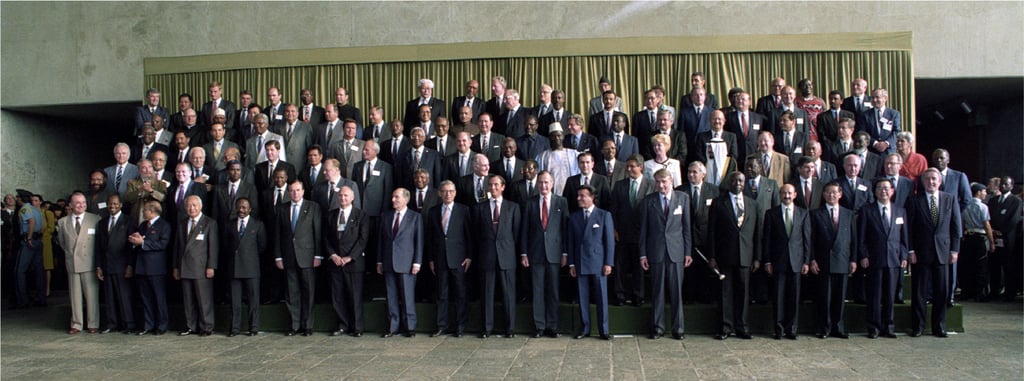
Group photo of world leaders meeting at the ‘Earth Summit’ in Rio de Janeiro, Brazil, 13 June 1992. UN Photo/Michos Tzovaras (80)
This section outlines key concepts and guiding principles that shape global environmental and sustainable development governance. Many of these principles originate from the 1992 Rio Declaration on Environment and Development, which articulated 27 foundational principles for achieving sustainable development worldwide. These ideas build upon earlier milestones, including the 1972 Stockholm Declaration and the 1987 Brundtland Commission’s landmark definition of sustainable development:
“Sustainable development is development that meets the needs of the present without compromising the ability of future generations to meet their own needs.”
The following section highlights several of the most influential principles from the Rio Declaration that continue to underpin international environmental and sustainable development policy as well as governance today.
The Precautionary Principle
The precautionary principle, articulated as Principle 15 of the 1992 Rio Declaration on Environment and Development, established a key foundation for global environmental governance and sustainable development. It states:
“In order to protect the environment, the precautionary approach shall be widely applied by States according to their capabilities. Where there are threats of serious or irreversible damage, lack of full scientific certainty shall not be used as a reason for postponing cost-effective measures to prevent environmental degradation.”
The precautionary principle holds that a lack of complete scientific certainty should not delay action to prevent potential environmental harm. In other words, it shifts the burden of proof; rather than requiring conclusive evidence of damage before taking protective measures, it calls on science and policymakers to demonstrate that an activity does not pose a threat before allowing it to proceed. If such certainty cannot be established, governments and the international community are expected to act as though a risk exists.
The principle carries important implications for human rights. It suggests that communities whose well-being and livelihoods depend on healthy ecosystems have a right to have those systems protected as a matter of course. The absence of scientific proof that an environment is in danger should not invalidate a community’s right to safeguard the natural systems that sustain them.
While the precautionary principle appears in numerous international agreements and national laws, it lacks a universally accepted definition or application. A study by Stewart (2002) identified 14 variations of the principle, which can be broadly grouped into four core interpretations:
- Non-Preclusion Principle: Scientific uncertainty should not automatically prevent regulation of activities that may cause serious harm.
- Margin of Safety Principle: Regulations should incorporate a safety buffer by limiting activities to levels well below those expected to cause harm.
- Best Available Technology (BAT) Principle: Activities with uncertain but potentially serious risks should use the best available technology to minimise harm unless proven otherwise.
- Prohibition Principle: Activities with uncertain but potentially serious risks should be prohibited unless demonstrated to pose no significant threat.
For the precautionary principle to function effectively, a balance must be found between scientific evidence and policy action. Policymakers often require solid data before investing political capital in new environmental measures, making proactive regulation difficult. Critics also argue that applying the principle too broadly could be impractical or costly, as countless human activities carry some degree of environmental uncertainty.
Nevertheless, in theory, the precautionary principle offers a powerful framework for protecting fragile ecosystems and the communities that depend on them—if applied consistently and supported by political will and practical mechanisms for enforcement.
The ‘Polluter Pays’ Principle
The polluter pays principle, outlined in Principle 16 of the Rio Declaration, establishes that those responsible for pollution should bear the costs of preventing and managing environmental damage. It encourages governments to integrate environmental costs into economic decision-making and to use financial and regulatory tools that hold polluters accountable—while safeguarding the public interest and avoiding unfair impacts on trade or investment.
The concept first appeared at the international level in a 1972 OECD Council Recommendation on Guiding Principles Concerning International Economic Aspects of Environmental Policies (81). The recommendation stated that assigning the costs of pollution control to the polluter would promote the efficient use of environmental resources and prevent trade distortions. It further clarified that polluters should cover the expenses required to maintain environmental quality at an acceptable level, as determined by public authorities.
The ‘polluter pays’ principle, Principle 16, of the Rio Declaration reads:
“National authorities should endeavour to promote the internalization of environmental costs and the use of economic instruments, taking into account the approach that the polluter should, in principle, bear the cost of pollution, with due regard to the public interest and without distorting international trade and investment.”
This principle seeks to ensure that any party who causes environmental pollution is held responsible for paying the costs for the environmental damage done. On an international level, it has wide-reaching implications for the respective responsibilities of nation-states in addressing global environmental problems. In the context of climate change negotiations, it is often invoked by some to argue that historically high-emitting states should take the lead in tackling climate change and incurring the costs of responding to its impacts. The principle also provides a rationale for the establishment of regulatory frameworks for tax and other measures which integrate ‘environmental externalities’ into the costs of products and activities. It is suggested that there would be a strong incentive to invest in more sustainable models of production by making environmentally damaging activities more costly.
There are several challenges to the implementation of the ‘polluter pays’ principle. Firstly, on a global level, it can be difficult to establish the respective responsibilities of different states, for example, in the climate change context, due to the complex issues related to attribution of causality. There may also be a historic dimension to environmental degradation – whilst some states engage in activities today that are highly environmentally damaging, their historic contribution to environmental pollution may have been insignificant. On a national level, it is also challenging to implement the principle with consistency, as the potential impact on particular key industries may be too dramatic to be politically feasible. There are also some significant challenges around equity – even if applied consistently, the principle in theory could be seen as allowing those with greater financial resources to buy their way out of regulation, whilst those with more modest means are forced to make sacrifices.
Debates around the polluter pays principle remain central to contemporary environmental policy. The concept has underpinned arguments for the creation of the Loss and Damage Fund, established at COP 27 in Sharm El-Sheikh, Egypt (2022), which calls for wealthier nations to support countries in the Global South that are disproportionately affected by climate impacts.
In recent years, attention has also turned to the valuation of ecosystems—recognising the economic worth of the goods and services nature provides, such as clean water, carbon storage, and pollination. This approach represents an evolution of the polluter pays principle, extending it to account for the hidden costs of environmental degradation. A landmark study by UNEP and partners, The Economics of Ecosystems and Biodiversity (TEEB), highlighted that many of the world’s largest and most profitable companies would face significant financial challenges if the true value of ecosystem services were fully reflected in their operating costs.
Common but Differentiated Responsibilities
The origins of the term ‘common but differentiated responsibilities’ can be traced back to the 1972 UN Conference on the Human Environment in Stockholm. However, it was not until 1992 during UNCED that the phrase became ‘formally enunciated as a principle’ and assumed an integral part of the Rio Declaration on Environment and Development. Principle 7 states:
“In view of the different contributions to global environmental degradation, States have common but differentiated responsibilities. The developed countries acknowledge the responsibility that they bear in the international pursuit of sustainable development in view of the pressures their societies place on the global environment and of the technologies and financial resources they command.”
This principle underscores the responsibility of each nation to contribute to addressing environmental and sustainable development challenges that cross national borders and cannot be solved by any one country alone. The level of responsibility varies depending on a nation’s economic strength, technological capacity, and historical role in contributing to environmental degradation.
The concept was subsequently enshrined in the UNFCCC, which emphasises that climate change is a ‘common concern of humankind’. However, it also recognises the legitimate need and right of developing countries to pursue economic growth in a sustainable manner and in a way that is consistent with the goal of reducing poverty. It also stipulates that developed countries must lead the way in climate change mitigation, requiring them to display how they are assisting developing countries to meet their obligations through the transfer of finance and technology, as well as meeting their own commitments and targets.
The principle of common but differentiated responsibility became a cornerstone of international climate negotiations, guiding the work of the UNFCCC Conferences of the Parties (COPs) and formally incorporated into the Kyoto Protocol in 1997. Though the principle had taken centre stage during earlier climate change negotiations, this was the first time the concept was included in a legally binding international agreement. The principle continues to be invoked through the UNFCCC to suggest that nation-states that have historically been responsible for carbon emissions should commit greater resources to climate change mitigation and adaptation globally. However, it is also increasingly interpreted to apply to the current circumstances of nation-states, thereby bestowing responsibility upon economies in transition.
Common but Differentiated Governance (CBDG)
Inspired by the principle of CBDR, an often-cited publication (82), (Meuleman & Niestroy 2015), suggested a similar principle for sustainability governance: We have common goals that are universal but circumstances (administrative, ecological, social, economic, as well as with regard to culture and traditions – what works where and why?) mean that there are no one-size fits all solutions, and so-called ‘best practices’ are rare. Successful practices in one country often need to be adapted to work in another country. If this is not done, governance failure can undermine the implementation of any policy, law, or strategy. This not only applies to sustainable development but also to environmental sustainability. How this can work for the SDGs, creating situational mixtures of three typical governance styles – hierarchical (top-down/legal), network (collaborative) and market (using market tools) – that differ in 50 features, was elaborated in ‘Metagovernance for Sustainability’(83).
Access to Information, Participation, and Justice
The principle of access to information, participation and justice in environmental decision-making, Principle 10, states:
“Environmental issues are best handled with participation of all concerned citizens, at the relevant level. At the national level, each individual shall have appropriate access to information concerning the environment that is held by public authorities, including information on hazardous materials and activities in their communities, and the opportunity to participate in decision-making processes. States shall facilitate and encourage public awareness and participation by making information widely available. Effective access to judicial and administrative proceedings, including redress and remedy, shall be provided.”
Principle 10 introduces accountability, transparency, and democratic empowerment into decision-making on environmental matters. Through having access to information about environmental impacts, greater transparency is brought to the environmental decision-making process. Through access to participation, citizens can actively engage with decision-making through consultations and dialogue and make constructive proposals so that planning and legislation better reflect their needs. Through access to justice, citizens have access to redress and remedy, to protect their access to information and participation and to challenge decisions that do not take their needs into account (84).
Principle 10 is unevenly implemented globally, and in some cases, where laws exist, mechanisms to impart comprehensive environmental information to the public may still be lacking. In many developed countries, there has been an improvement in laws to grant citizens greater access to information, and a commitment to better engagement, consultation and participation in environmental matters. In practice, however, many of these laws exist on paper only. Efforts to enhance participation in decision-making in some cases are often top-down affairs that take place towards the end of a decision-making process, where the capacity to influence the outcome has been minimised. Additionally, access to justice remains constrained by ‘obstacles of cost, lack of clarity about procedures for appeal, and also the lack of standing as a legally recognised party with a legitimate interest in the case’(85).
One of the most comprehensive efforts to implement Principle 10 is the UN Economic Commission for Europe (UNECE) Convention on Access to Information, Participation in Decision-making, and Access to Justice in Environmental Matters, also called the Aarhus Convention after the city in Denmark where it was adopted in 1998. UNECE negotiated the Convention as a regional convention to be signed and ratified by countries, mainly in Europe and central Asia, that fall under its remit. The Convention was referred to by former UN Secretary-General Kofi Annan as the ‘most ambitious ventures around environmental democracy so far undertaken under the auspices of the United Nations’. 60 Building on the inspiration provided by the Aarhus Convention, the Escazú Agreement, adopted in March 2018, was the first environmental treaty of Latin America and the Caribbean and the only one to emerge directly from the Rio+20 process, further advancing Principle 10 in a new regional context.
At the UNEP Governing Council in 2010, a series of guidelines were approved for the development of national legislation on access to information, public participation and justice on environmental matters (86). While these guidelines draw heavily on the Aarhus Convention, they remain non-binding, so there is no process for reporting, monitoring or review. To address this issue, the World Resources Institute and the Access Initiative have launched a campaign towards the UN Conference on Sustainable Development 2012 to make the case for regional conventions on environmental access rights (87). It is argued that the regional approach is the most likely to lead to success; whilst the Aarhus Convention does allow for the accession of non-UNECE states, any new members must be approved by the Conference of the Parties of the Convention, which creates political difficulties as the Convention is widely viewed to be ‘Europe-centric’. Regional negotiation facilitates more regional ownership over the process and can overcome cultural and language barriers that are more prevalent on a global level. Importantly, it can also prevent the watering down of legislation to the lowest common denominator, which can sometimes be a challenge for global negotiations. The ambition is for the Rio+20 outcome document to call for the setting in motion of regional time-bound negotiations, overseen by the appropriate regional bodies.
Global Public Goods/The Global Commons
Environmental goods and services, such as the global oceans and the Earth’s atmosphere, are referred to as the ‘global commons’ or ‘global public goods.’ A public good of this kind is non-rival and non-excludable. This means that consumption or use of the good (e.g. the air we breathe) by one individual does not reduce the availability of that good to another.
The Tragedy of the Commons
In 1968, Garrett Hardin coined the term the ‘tragedy of the commons.’ This notion relates to the activity of people who are sharing public goods or a common resource without one being responsible for the management of the resource. According to Hardin, self-interested behaviour in relation to the sharing of a public or common resource can result in its mismanagement and degradation, unless someone has the authority to enforce rules and regulations that are in the interest of all concerned. A prominent example of the tragedy of the commons is in relation to instances of transboundary or atmospheric pollution.
During the negotiation of international laws such as the UN Convention on the Law of the Sea (88) in the 1970s and 1980s, there appeared to be enthusiasm to agree to govern the resources and goods of the global commons by a principle known as ‘the common heritage of humankind’.64 Common heritage resources have been defined as ‘those [resources that] are owned by all nations, not one; that are managed multilaterally, not unilaterally, with the benefits of that management shared by all; and are used for peaceful purposes only’ (89). However, the lack of agreement on using the principle of ‘the common heritage of mankind’ and the noticeable absence of the principle in international law and MEAs illustrate that the concept of a common heritage has not been approved or widely accepted by many states.
In place of the common heritage principle, there is a similar, but arguably less effective, concept of ‘the common concern of humankind’. The ‘concern’ relates to the human interest in preserving the planetary goods and resources and in maintaining and protecting the global commons. Two important MEAs that address these concerns are the UN Convention on Biological Diversity and the UN Framework Convention on Climate Change. ‘Unlike the common heritage concept, common concern does not imply legal obligations, but it does signify the openness of the international community to regulate resources that would otherwise be strictly within the control of the sovereign nations’ (90).
International Governance of the Global Commons
There is a distinction between global commons goods, or public goods, and private goods. Adam Smith, an early champion of free entrepreneurship, is understood to have presupposed a healthy balance between public and private goods (91). However, it has been argued that globalisation has destroyed 32 such a balance and that markets nowadays work worldwide, while the institutions and laws that generate, safeguard and control public goods have remained essentially national (92). Thus, it is understood that the case for stronger international governance of public and common goods should exist to enhance and rebalance the harmony of the relationship between private and public goods. As such, proponents of strengthening the governance of the global commons are keen to protect the kind of public goods that are ‘vulnerable’ to ‘destructive cherry picking on the part of private investors (93).
Propositions have been made for the creation of a Global Environment Organisation (GEO) to focus specifically on environmental issues that are global in scope, such as transboundary atmospheric pollution and management of shared natural resources—the so-called “global commons” (94). They distinguish these from “world” environmental issues, which affect all countries but do not necessarily require coordinated global responses, such as localised water pollution or land-use practices. While this distinction can help clarify the potential remit of a GEO and the roles of nation-states relative to international institutions, it is inherently ambiguous. For example, forests might be classified as “global” because of their impact on greenhouse gas emissions, whereas land management is often considered a national or local concern. In reality, land-use changes can have major consequences for ecosystems, biodiversity, and carbon emissions, all of which have global effects. This complexity has been acknowledged in international policy through the UNFCCC’s specific work programme on land use, land-use change, and forestry.
Intergenerational Equity
As has already been noted, the 1987 Brundtland Report’s definition of sustainable development explicitly enshrines recognition of the responsibility one generation has to subsequent generations (95).
This broad sustainable development paradigm raises interesting questions about how societies can deliver an equal range of development choices to both present and future generations, and what form or direction development should take if it is to be sustainable. The Report also emphasised that many environmental problems result from disparities in economic and political power. Another influential study, the 1991 report Caring for the Earth, (96). emphasised the importance of maintaining development within the earth’s carrying capacity, that is, within the limits of the renewal and recycling processes which enable the biosphere to provide renewable resources, assimilate wastes and provide other environmental goods and services. This concept remains central to the current understanding of sustainable development.
A development that furthered this concept focused on nine planetary boundaries that made up the carrying capacity of the earth and detailed the ‘safe operating space for humanity’ (97). Planetary boundaries science offered a conceptual framework that underpinned the need for development to be inherently sustainable if humanity was to remain within this ‘safe operating space’. This concept gained attention during the preparatory meetings for Rio+20, and a discussion paper was published that argued for recognition of a ‘social floor’ and a commitment not to fall below it, thus defining a ‘doughnut’ space that humanity must live within (98). Successfully developing sustainably and equitably, coupled with living within the planetary boundaries and above the social floor, went a long way toward putting the principle of intergenerational equity into practice (99).
Sustainable development broadly requires that the well-being of the present generation should not be increased at the expense of the welfare of future generations, and that society’s well-being should not decline over time. The next generation can only produce as much well-being as the present one if it has the same stock of capital available to it. To put it in simple terms, sustainability implies ‘living off the interest’, rather than ‘living off the capital’. The capital stock can be thought of as comprising three types of capital:
- Natural capital, such as forests, air, water, soils and biodiversity (normally referred to as environmental resources), and other resources such as minerals and aggregates;
- Human capital, such as human resources, skills, and knowledge;75
- Human-made capital, such as manufactured capital and goods, machinery, infrastructure, buildings, and other forms of physical plant.
Sustainability, therefore, requires that, at a minimum, a country should maintain a constant stock of aggregate capital over time. The choice it makes about the composition of the continuous capital stock to be maintained will determine whether it is on a path towards:
- Weak sustainability, where it substitutes natural capital with human, or human-made, capital (e.g. it depletes half of its primary forests to build factories or tourist resorts); or
- Strong sustainability, where it does not substitute natural capital with other forms (e.g. it conserves a permanent estate of primary forest).
For renewable resources (e.g., fish, forests, water) and sinks for wastes (e.g., the atmosphere) to be used at sustainable levels, the rate of harvesting them (or discharge of emissions) must not exceed their rate of regeneration or assimilative capacity. Non-renewable natural resources such as minerals do not regenerate, and in their case, sustainability becomes a question of maintaining utility over time, either by expanding reserves (through recycling, efficiency gains and exploration), or by investing income surpluses in alternative resources that will be available for future generations.
Decisions need to be made by society about the acceptable limits of substitution between natural, human and human-made capital. This requires an estimate of the critical minimum natural capital (or types of natural capital) that is needed to ensure the survival of ecosystems and the biosphere. Such an estimate is very difficult to achieve because of the degree of uncertainty in our understanding of the biosphere’s complex, dynamic and interrelated processes. Uncertainty is endemic to environmental science and makes sustainability, in practice, imprecise. For this reason, environmentalists have increasingly advocated the precautionary principle (see above), which urges decision-making to err on the side of caution, even when all the scientific facts are not fully known, to ensure that sustainability limits are not breached. The choices and risks that are inherent in this process need to be negotiated and agreed upon within countries, and also between countries in the case of global commons and global public goods. The process of negotiation and decision-making, it is argued, requires effective capabilities in governance, policy, science and technology, and the interface between them:
- A governance capacity: to enable countries, through open and participatory processes, to agree sustainable development goals and the trade-off between weak and strong sustainability; address issues of environmental risk; agree and effectively implement policies to steer development along a sustainable path; and collaborate regionally and internationally on the management of global commons.
- A scientific and technological capacity: to determine carrying capacities and indicators; set baselines and suggest precautionary limits; monitor environmental changes; deepen understanding of environmental processes (at local and global levels); and develop or adapt technologies to ensure that development takes place within environmental limits.
For the well-being of future generations to be reflected in institutional arrangements, several governmental and non-governmental actors promote the establishment of a national commissioner, ombudsman, or ‘guardian’ for future generations. The role of such a position is to monitor and review actions across all government departments to evaluate the extent to which decisions are being made in the long-term interest, and thereby to assess the impact on future generations. This has been put into practice by Hungary, whose Parliament has appointed a Commissioner for Future Generations (100).
Environmental Integration & Policy Coherence
The environmental integration principle, which aims to incorporate environmental considerations into policies and regulatory instruments in fields outside environmental policy and law, initially emerged and evolved in International and subsequently in EU Law. Since its emergence, the environmental integration principle has been closely linked to the concept of sustainable development, given that the principle is perceived as a key instrument for its realisation.
The principle was reinvigorated when it became part of the SDG target 17.14 on Policy Coherence for Sustainable Development (PCSD), as an elaboration of the existing principle of Policy Coherence for Development (PCD). PCD focused on the coherence within development cooperation. With the universality of the SDGs, it is now focused on the domestic as well as international policy of all countries.
UNEP is the custodian agency for the PCSD indicator 17.14.1. This is a composite indicator with eight sub-indicators, mostly about governance aspects (e.g. horizontal coordination between ministries; vertical coordination between levels of administration; and coordination with stakeholders). The OECD (101) has supported countries (also non-OECD; one project was with the African Peer Review Mechanism (APRM)) during the past years in setting up PCSD action plans. UNEP published a handbook (102) on how to use the indicator.
References
80 United Nations. United Nations Conference on Environment and Development (Rio Earth Summit). 1992.https://www.un.org/en/conferences/environment/rio1992
81 Organisation for Economic Co-operation and Development. Recommendation of the Council on Policy Coherence for Sustainable Development. 2019.https://legalinstruments.oecd.org/public/doc/4/4.en.pdf
82 Meuleman, Louis. Metagovernance for Sustainability: A Framework for Implementing the Sustainable Development Goals. London: Routledge, 2018.https://www.mdpi.com/2071-1050/7/9/12295
83 World Resources Institute. Content Reference 8080. https://www.routledge.com/Metagovernanc e-for-Sustainability-A-Framework-for-Implementing-the-Sustainable-Development-Goals/Meuleman/p/book/9780367500467?srsltid=AfmBOooZp_iekvU5m7HA6CQIy6aM0QktTdaNX8PidS4SP0PxGubmOh1g
84 World Resources Institute. Content Reference 8080.http://www.wri.org/publication/content/8080
85 United Nations Environment Programme. Guidelines for the Development of National Legislation on Access to Information, Public Participation and Access to Justice in Environmental Matters. 2010.http://www.wri.org/publication/content/8080
86 Stakeholder Forum for a Sustainable Future. Stakeholder Forum. http://www.unep.org/DEC/PDF/GuidelinesAccesstoJustice2010.pdf
87 United Nations. United Nations Convention on the Law of the Sea. 1982.http://www.stakeholderforum.org/
88 Speth, James Gustave, and Peter M. Haas. “Toward Planetary Stewardship.” In Global Environmental Governance, 7. Washington, DC: Island Press, 2006. https://www.un.org/depts/los/convention_agreements/texts/unclos/unclos_e.pdf
89 Speth, James Gustave, and Peter M. Haas. “Toward Planetary Stewardship.” In Global Environmental Governance, 7. Washington, DC: Island Press, 2006.
90 JG Speth and PM Haas (2006). ‘Toward Planetary Stewardship’, in Global Environmental Governance, Island Press, Washington, DC, p. 7.
91 von Weizsäcker, Ernst Ulrich. “UNEO May Serve to Balance Public and Private Goods.” In Keynotes and Mission Statements for the Path Ahead, edited by Andreas Rechkemmer, 39. Berlin: Stiftung Wissenschaft und Politik, 2005.
92 Ibid.
93 Ibid.
94 Yale School of the Environment. Environmental Governance Publication. https://elischolar.library.yale.edu/fes-pubs/8/
95 World Commission on Environment and Development. Our Common Future. Oxford: Oxford University Press, 1987.
96 Published by the World Conservation Union, UNEP and the World Wide Fund for Nature.
97 Rockström, Johan, et al. “A Safe Operating Space for Humanity.” Nature 461 (2009): 472–475.
98 Raworth, Kate. A Safe and Just Space for Humanity: Can We Live Inside the Doughnut? Oxfam Discussion Paper. Oxford: Oxfam, 2012.
99 Schneeberger, Klaus. “Those Yet to Be Born: Representing the Interests of Future Generations.” In Regeneration, 188–196. http://www.lwbooks.co.uk/ebooks/Regeneration.pdf
100 World Future Council. Guarding Our Future: How to Include Future Generations in Policy Making. Hamburg, Germany, 2010. http://www.worldfuturecouncil.org/fileadmin/user_ upload/PDF/brochure_guardian3.pdf, pp. 6–7
101 Organisation for Economic Co-operation and Development. Policy Coherence for Sustainable Development. https://www.oecd.org/en/topics/policy-coherence-for-sustainable-development.html
102 Organisation for Economic Co-operation and Development. Policy Coherence for Sustainable Development. https://www.unep.org/resources/publication/policy-coherence-sustainable-development-handbook-indicator-17141-sustainable