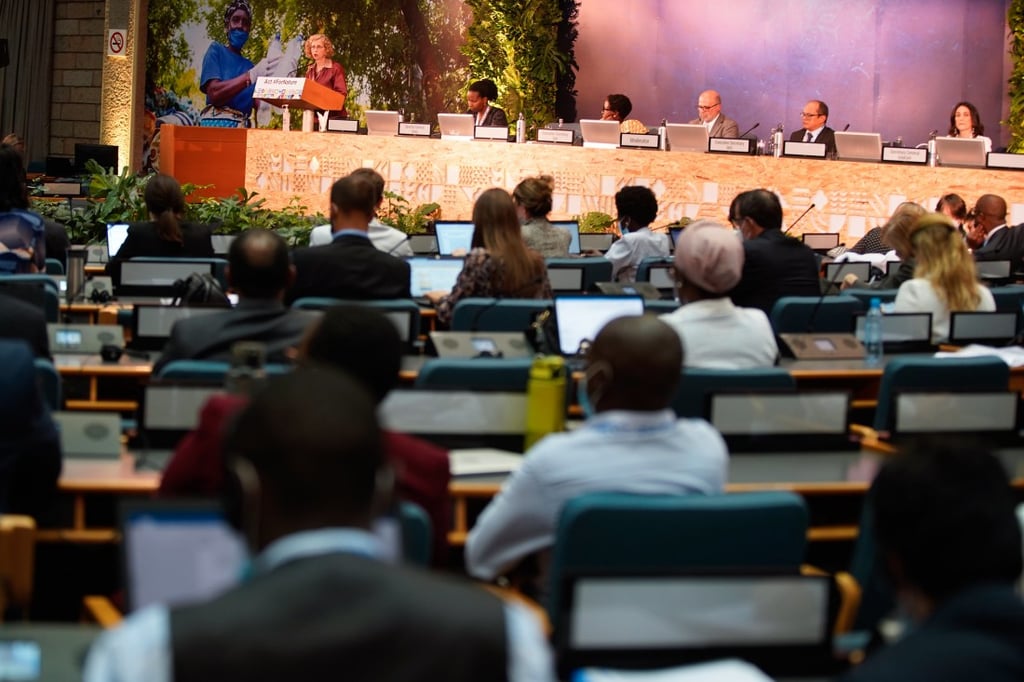
Source: UN Environment Assembly (103)
Sustainable development governance refers to the systems, institutions, and decision-making processes that guide and coordinate actions across governments, sectors, and stakeholders to achieve balanced economic growth, social equity, and environmental protection for present and future generations.
Sustainable Development Governance
The UN General Assembly
The UN General Assembly (104) serves as the main decision-making and representative body of the United Nations, responsible for debate, policy formulation, and collective action on global issues. Accordingly, the General Assembly provides a global forum for multilateral dialogue on the wide range of issues addressed by the UN Charter. While the Charter does not explicitly mention the environment or sustainable development, these themes fall within the Assembly’s broader mandate to initiate studies and make recommendations that foster international cooperation in economic, social, cultural, educational, and health matters. In addition, the General Assembly, often guided by the agenda-setting role of the UN Secretary-General, shapes global priorities by elevating emerging issues and directing international attention and action toward them.
A number of resolutions have been adopted by the General Assembly, which reaffirm the interconnected nature of social, economic, and environmental development, with some of the main highlights including the following declarations from major summits on sustainable development:
- The UN Conference on Environment and Development (UNCED) (105) in 1992
- Rio+5 (Earth Summit) (106) in 1997
- Millennium Declaration (107) in 2000,
- World Summit on Sustainable Development (108) in 2002
- Rio+20 (109) in 2012
- The 2030 Agenda for Sustainable Development (110), including the SDGs in 2015.
Through these resolutions, sustainable development has been firmly integrated into the UN’s agenda. The General Assembly addresses sustainable development not only by setting international standards and drafting guidelines, but also by supporting the implementation of measures and policies adopted by member states (111). It liaises with all other UN bodies to achieve improved coordination of UN activities on sustainable development-related issues.
As the main representative body of the UN, the General Assembly is composed of 193 Member States, each allowed one vote. It operates through six main committees and subsidiary bodies, including the Second Committee (Economic and Financial), which deals directly with sustainable development and environmental issues. They provide overall policy guidance to the Economic and Social Council (ECOSOC) and UN system entities on sustainable development.
The Second Committee of the General Assembly
The Second Committee, or the Economic and Financial Committee (ECOFIN) (112), is a committee within the United Nations that addresses issues in the areas of global finance and economics, including issues relating to international trade, financing for development, sustainable development and poverty eradication. Although the Second Committee is mainly concerned with macroeconomic issues, a large part of its work focuses on development and sovereignty over natural resources. Indeed, it deals with issues relating to country groupings with special circumstances, such as the least developed countries, regarding natural resources. Furthermore, the Second Committee is responsible for coordinating the implementation and follow-up to several conferences and programmes on sustainable development and global poverty, such as the United Nations Decade for the Eradication of Poverty (113), the World Summit on Sustainable Development, Rio+20, and Agenda 2030 for Sustainable Development.
The Economic and Social Council
The Economic and Social Council (ECOSOC) (114) is composed of 54 UN member states, elected by the General Assembly. Its role is to coordinate and strengthen UN activities in economic, social, and related fields, ensuring that sustainable development—including environmental considerations—is integrated across UN policies and programs. ECOSOC also conducts studies, publishes reports on international issues such as health, education, and sustainable development, and makes recommendations to the General Assembly, member states, and specialised agencies. By providing a platform for policy formulation and coordination, ECOSOC serves as a key body for promoting coherent and comprehensive approaches to sustainable development across the UN system.
UN Conference on Trade and Development
The UN Conference on Trade and Development (UNCTAD), in collaboration with UNEP and UNDESA, has contributed to several initiatives aimed at integrating sustainable development into trade and economic governance. Key contributions include:
- Developing a vulnerability index to support quantitative and analytical work on the vulnerability of small island developing states (1998), alongside a review of voluntary industry initiatives.
- Establishing UN guidelines on consumer protection, incorporating sustainable consumption, and launching an open-ended consultation process on oceans and seas under the UN General Assembly (1999).
- Creating a new permanent body, the UN Forum on Forests, to strengthen international coordination on forest governance (115).
UN Environment Organisation
Proposals to strengthen UNEP by upgrading it to a specialised agency, institution, or World Environment Organisation (WEO) have been under discussion at the intergovernmental level for over two decades. These proposals aim to provide UNEP with greater authority, predictable funding, and an elevated role in the international environmental governance hierarchy, reflecting similar ambitions to establish a World Environment Organisation (WEO) or a Global Parliament for the Environment.
Environmental Management Group
The Environmental Management Group (EMG) (116) is an inter-agency coordination mechanism for environmental issues across the UN system. It was established in 2001, following General Assembly Resolution 53/242, which endorsed the Secretary-General’s proposal to strengthen cooperation on environment and human settlements.
The primary goal of the EMG is to address inefficiencies and overlaps within the international environmental governance architecture (117). Enhancing system-wide coherence has become increasingly critical as the growing number of multilateral environmental agreements (MEAs), institutions, and processes has contributed to the fragmentation of environmental governance (118). The EMG’s membership includes UN specialised agencies, programmes, and organs, along with the secretariats of MEAs. The group is chaired by the Executive Director of UNEP (119).
The EMG facilitates and supports a variety of UN consultative processes designed to improve understanding and coordination in environmental governance. It was invited by the Governing Council of UNEP to assist the Consultative Group of Ministers and High-level Representatives in their work on reforming the broader international environmental governance system (120).
Beyond its system-wide coordination role, the EMG also contributes to mainstreaming environmental considerations at the national level through operational support. By helping countries develop coherent national frameworks to fulfil their multilateral environmental obligations, the EMG strengthens both international cooperation and national environmental governance practices.
The World Trade Organisation
As part of the economic pillar of sustainable development, it has been widely acknowledged that the global sustainable development framework holds limited authority over economic governance. This domain remains largely influenced by powerful intergovernmental groups such as the G8, G20, Major Economies Forum (MEF), and the World Trade Organisation (WTO). While global summits on sustainable development have produced aspirational outcome documents, meaningful progress toward these commitments remains constrained without broader reform across these economic systems. Conflicts have often arisen between legally binding environmental obligations and WTO trade rules, while many of the principles set out in the 1992 Rio Declaration remain at odds with a global financial system that, even after the financial crisis, operates with limited regulation.
The World Trade Organisation serves as the primary international institution for negotiating and regulating global trade, with a mandate to promote free trade and stimulate economic growth. However, the WTO has often faced criticism for failing to adequately integrate environmental policies into its trade framework. Critics argue that the environmental and social consequences of trade and labour movements are frequently overlooked and that the WTO’s structure and mandate are ill-equipped to incorporate the environmental dimensions of trade. Some have even suggested the creation of a new international institution dedicated to ensuring that trade and environmental agreements are mutually supportive.
Committee on Trade and Environment
Within the WTO, the Committee on Trade and Environment (CTE) serves as a key forum for examining the intersection of trade and environmental policy. In preparation for the 2003 CTE Special Session, several multilateral environmental agreement (MEA) secretariats were granted ad hoc invitee status, allowing them to contribute directly to WTO deliberations. UNEP played a facilitative role in these dialogues, helping to strengthen collaboration between the CTE and environmental bodies, to ensure that considerations on issues relating to the environment and sustainable development could meaningfully inform WTO negotiations (121).
In July 2006, however, the Doha Round of multilateral trade negotiations was suspended for six months, exposing persistent tensions within the WTO system. Since then, the CTE has continued to meet in Special Session formats, focusing on the Doha Development Agenda, particularly paragraph 31(i), which addresses the relationship between WTO rules and trade obligations in multilateral environmental agreements. Despite ongoing discussions, the WTO Director-General has urged that the Doha negotiations must be “taken up to a higher gear” if sustainable development is to be fully integrated into global trade processes (122).
The High-level Political Forum on Sustainable Development
The High-level Political Forum (HLPF) (123) was established by the Rio+20 outcome document, The Future We Want, agreed at the United Nations Conference on Sustainable Development in 2012. The mandate and goals of the HLPF are to conduct in-depth reviews of progress on the Sustainable Development Goals (SDGs) (124), which include Voluntary National Reviews (125) where countries present the findings from national reviews of progress with a view to accelerating the implementation of the 2030 Agenda.
While the HLPF meets every year to track progress on the SDGs, once every four years it holds a special, high-level session called the SDG Summit (126). This summit, organised under the UN General Assembly, brings together Heads of State and Government to review global progress and set priorities for the years ahead. The SDG Summit serves as a major global checkpoint, providing an opportunity for world leaders to take stock of progress toward the implementation of the SDGs, assess challenges, and set priorities for the next phase of implementation. The next SDG Summit is scheduled for September 2027, continuing the tradition of four-yearly reviews that complement the HLPF’s annual work. The first SDG Summit (127) was held in September 2019, while the second SDG Summit (128), in September 2023, adopted the 2023 Political Declaration (129).
Themes for the HLPF
| 2025 | ||
| Goal | Target | Indicator |
| Good Health and Well-Being (Goal 3) | 3.2: By 2030, end preventable deaths of newborns and children under‑5 years of age, with all countries aiming to reduce neonatal mortality to at least 12 per 1,000 live births and under‑5 mortality to at least 25 per 1,000 live births¹ | 3.2.1: Under‑5 mortality rate¹ |
| Gender Equality (Goal 5) | 5.5: Ensure women’s full and effective participation and equal opportunities for leadership at all levels of decision‑making in political, economic, and public life² | 5.5.1: Proportion of seats held by women in (a) national parliaments and (b) local governments² |
| Decent Work and Economic Growth (Goal 8) | 8.5: By 2030, achieve full and productive employment and decent work for all women and men, including young people and persons with disabilities, and equal pay for work of equal value³ | 8.5.2: Unemployment rate, by sex, age, and persons with disabilities³ |
| Life Below Water (Goal 14) | 14.4: By 2020, effectively regulate harvesting and end over‑fishing, illegal, unreported, and unregulated fishing; restore fish stocks to levels that can produce maximum sustainable yield³ | 14.4.1: Proportion of fish stocks within biologically sustainable levels³ |
| Partnerships for the Goals (Goal 17) | 17.17: Encourage and promote effective public, public–private, and civil society partnerships³ | 17.17.1: Amount in US dollars committed to public–private partnerships for infrastructure³ |
| 2026 | ||
| Goal | Target | Indicator |
| Clean Water and Sanitation (Goal 6) | 6.1: By 2030, achieve universal and equitable access to safe and affordable drinking water for all¹ | 6.1.1: Proportion of population using safely managed drinking water services³ |
| Affordable and Clean Energy (Goal 7) | 7.1: By 2030, ensure universal access to affordable, reliable, and modern energy services⁴ | 7.1.2: Proportion of population with primary reliance on clean fuels and technology⁴ |
| Industry, Innovation, and Infrastructure (Goal 9) | 9.5: By 2030, enhance scientific research and upgrade technological capabilities of industrial sectors, including for developing countries⁴ | 9.5.1: Research and development expenditure as a proportion of GDP⁴ |
| Sustainable Cities and Communities (Goal 11) | 11.6: By 2030, reduce the adverse per‑capita environmental impact of cities, including air quality and municipal waste management⁴ | 11.6.2: Annual mean levels of fine particulate matter (PM2.5) in cities⁴ |
| Partnerships for the Goals (Goal 17) | 17.16: Enhance the global partnership for sustainable development, complemented by multi‑stakeholder partnerships³ | 17.16.1: Number of countries reporting progress in multi‑stakeholder development effectiveness monitoring frameworks³ |
| 2027 | ||
| Goal | Target | Indicator |
| Quality Education (Goal 4) | 4.1: By 2030, ensure all girls and boys complete free, equitable and quality primary and secondary education⁴ | 4.1.1: Proportion of children and young people achieving at least a minimum proficiency level in reading and mathematics⁴ |
| Reduced Inequalities (Goal 10) | 10.2: By 2030, empower and promote the social, economic, and political inclusion of all, irrespective of age, sex, disability, race, ethnicity, origin, religion, or other status⁴ | 10.2.1: Proportion of people living below 50 % of median income, by age, sex, and persons with disabilities⁴ |
| Responsible Consumption and Production (Goal 12) | 12.2: By 2030, achieve the sustainable management and efficient use of natural resources⁴ | 12.2.1: Material footprint, material footprint per capita, and material footprint per GDP⁴ |
HLPF table references:
¹ United Nations Statistics Division, SDG Metadata for Goals 3 & 6:https://unstats.un.org/sdgs/metadata/
² United Nations Statistics Division, SDG Metadata for Goal 5:https://unstats.un.org/sdgs/metadata/
³ United Nations Statistics Division, Global Indicator Framework for SDGs:https://unstats.un.org/sdgs/indicators/indicators-list/
⁴ United Nations Department of Economic and Social Affairs – The Sustainable Development Goals: 17 Goals to Transform Our World:https://sdgs.un.org/goals
The next SDG Summit will be held in September 2027, convened under the auspices of the UN General Assembly, bringing together ministers and senior officials to assess progress on the SDGs and guide implementation efforts.
The Division for Sustainable Development Goals
The Division for Sustainable Development Goals (DSDG) operates under the United Nations Department of Economic and Social Affairs (UNDESA) (130) and serves as the secretariat to the HLPF. They provide substantive support and coordination for the function of HLPF through the preparation of analytical inputs, policy briefs, and progress reports (including the Global Sustainable Development Report) (131). They also coordinate with voluntary national reviews (VNRs) (132) that countries present to the forum.
Beyond supporting the HLPF, the DSDG also works across the UN system to integrate the SDGs into policies, planning, and programmes, ensuring cohesion amongst agencies, funds, and programmes. In essence, the HLPF provides the political and intergovernmental platform, while the DSDG is the technical and organisational backbone of the production, ensuring SDGs are monitored, reviewed, and mainstreamed throughout the UN system.
UN Sustainable Development Group
The UN Sustainable Development Group (UNSDG) (133) aims to advance the 2030 Agenda for Sustainable Development at the global, regional, and country levels. This agency ensures that the UN delivers as one, prioritising a unified framework of system-wide guidance, standards, and accountability for planning and results reporting on sustainable development.
It is chaired by the UN Deputy Secretary General and chaired operationally by the Administrator of the UN Development Programme (UNDP). UNSDG brings together heads of UN entities to coordinate policies, strategies, and operations that support the SDGs. The UN Development Coordination Office (DCO) serves as the secretariat of the UNSDG.
Inter-Agency and Expert Group of SDG Indicators
The Inter-Agency and Expert Group on SDG Indicators (IAEG-SDGs) (134) was created in March 2015 at the 46th session of the United Nations Statistical Commission, which was composed of Member States and regional and international agencies as observers. The IAEG-SDGs was tasked to develop and implement the global indicator framework for the Goals and targets of the 2030 Agenda. IAEG-SDGs developed this framework, and it was agreed upon two years later at the 48th session of the UN Statistical Commission in March 2017.
The annual work programme, agreed by the UN Statistical Commission each year in March, focuses on the implementation of the indicator framework. The group’s work involves keeping track of how the methods and definitions for measuring the SDGs are updated and improved. It also focuses on making sure data is broken down to show differences between groups (e.g., by gender, age, or location), managing three smaller teams that focus on specific technical areas, and helping countries share what they have learned about tracking progress toward the SDGs.
The IAEG-SDGs has working groups that focus on two principal areas: how countries share and manage SDG data, and how maps and location-based information are used to track progress. Another team has been set up to collect lessons learned from several years of SDG monitoring. Each group and team sets its own work plan and methods, decides how to coordinate with partners, and reports on its progress during IAEG-SDGs meetings. Participation is open not only to member countries but also to other interested governments, international organisations, researchers, and Major Group representatives who meet the group’s participation criteria.
References
103 United Nations Environment Programme. UN Environment Assembly.https://www.unep.org/environmentassembly/
104 United Nations. About the General Assembly.https://www.un.org/en/ga/about/
105 United Nations. United Nations Conference on Environment and Development (Rio Earth Summit). 1992. https://www.un.org/en/conferences/environment/rio1992
106 United Nations. Earth Summit (UNCED). 1992.https://www.un.org/esa/earthsummit/
107 Office of the United Nations High Commissioner for Human Rights. United Nations Millennium Declaration. 2000. https://www.ohchr.org/en/instruments-mechanisms/instruments/united-nations-millennium-declaration
108 United Nations. World Summit on Sustainable Development (Johannesburg Summit). 2002. https://www.un.org/en/conferences/environment/johannesburg2002
109 United Nations. Rio+20 United Nations Conference on Sustainable Development. 2012.https://sustainabledevelopment.un.org/rio20
110 United Nations. Transforming Our World: The 2030 Agenda for Sustainable Development. 2015.https://sdgs.un.org/2030agenda
111 United Nations General Assembly. 2005 World Summit Outcome. 2005., http://www.un.org/summit2005/documents.html, p. 32.
112 United Nations. Second Committee of the General Assembly. http://www.un.org/en/ga/second/index.shtml
113 United Nations. United Nations.https://www.un.org/en
114 United Nations Economic and Social Council. ECOSOC. https://ecosoc.un.org/en
115 Dodds, Felix, Michael Strauss, with Maurice Strong. “The Governance Gap.” In Only One Earth: The Long Road via Rio to Sustainable Development. London: Earthscan, 2012.
116 United Nations Environment Management Group. Environment Management Group (EMG). https://unemg.org/
117 United Nations Environment Programme. Terms of Reference of the Environmental Management Group. 2000. www.nyo.unep.org/pdfs/emgtor.pdf, p.1
118 United Nations Environment Programme. Reform of UNEP: Form to Follow Function. Report of the Multi-stakeholder Workshop, 8th Special Session of the Governing Council/Global Ministerial Environment Forum, March 29–31, 2004.
119 United Nations Environment Programme. Reform of UNEP: Form to Follow Function. Report of the Multi-stakeholder Workshop, 8th Special Session of the Governing Council/Global Ministerial Environment Forum, March 29–31, 2004.
120 United Nations Environment Management Group. International Environmental Governance Cooperation. http://www.unemg.org/Cooperation/InternationalEnvironmentGovernance/tabid/1198/Defaul t.aspx
121 Charnovitz, Steve. Addressing Environmental and Labor Issues in the World Trade Organization. Washington, DC: Progressive Policy Institute, 1999. http://www.dlc.org/ndol_ci.cfm? kaid=108&subid=128&contentid=649
122 World Trade Organization. “Lamy Tells Members to Bring Doha Negotiations to a Higher Gear.” Press release, October 19, 2010.http://www.wto.org/english/news_e/news10_e/tnc_dg_stat_19oct10_e.htm
123 United Nations. High-Level Political Forum on Sustainable Development. https://hlpf.un.org/
124 United Nations. High-Level Political Forum: In-depth Reviews of SDG Progress. https://hlpf.un.org/#:~:text=regular%20in%2Ddepth%20reviews%20of%20progress%20on%20the%20Sustainable%20Development%20Goals%C2%A0
125 United Nations. High-Level Political Forum: Voluntary National Reviews. https://hlpf.un.org/#:~:text=%C2%A0and%20includes-,Voluntary%20National%20Reviews%C2%A0,-where%20countries%20present
126 United Nations. SDG Summit. https://hlpf.un.org/sdg-summit
127 United Nations. First SDG Summit. 2019. https://hlpf.un.org/#:~:text=political%20declaration.%20The-,first%20SDG%20Summit%C2%A0,-was%20convened%20in
128 United Nations. Second SDG Summit. https://hlpf.un.org/#:~:text=September%202019.%20The-,second%20SDG%20Summit,-was%20held%20in
129 United Nations. Political Declaration of the SDG Summit. 2023. https://hlpf.un.org/#:~:text=adopted%20the%202023-,Political%20Declaration%C2%A0,-.
130 United Nations Department of Economic and Social Affairs. UN DESA. https://www.un.org/en/desa
131 United Nations. Global Sustainable Development Report. https://sdgs.un.org/gsdr
132 United Nations. Voluntary National Reviews. https://sustainabledevelopment.un.org/vnrs/
133 United Nations Sustainable Development Group. UNSDG. https://unsdg.un.org/
134 United Nations Statistics Division. Inter-Agency and Expert Group on SDG Indicators. https://unstats.un.org/sdgs/iaeg-sdgs/