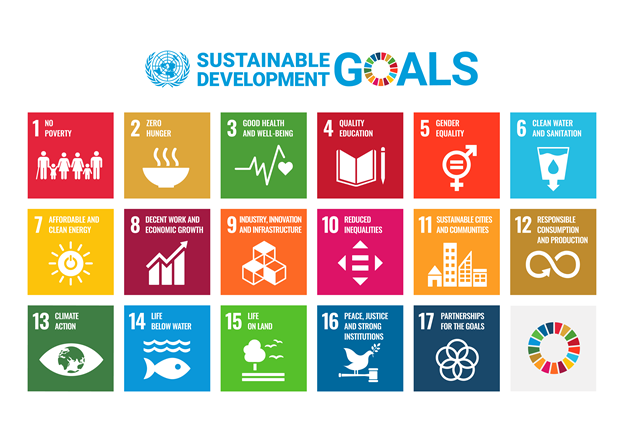
Sustainable Development Goals. Source (252)
Governance for the environment and for sustainable development today involves a diverse set of actors that operate beyond traditional state-led institutions, spanning research networks, policy think tanks, and advocacy organisations. These entities provide research, analysis, and recommendations that shape international environmental, social, and economic policy, strengthen accountability, and promote inclusive decision-making. They also foster multi-stakeholder collaboration, bridging gaps between governments, civil society, and the private sector. The following organisations exemplify the current landscape of global sustainable development governance initiatives.
Stimson Center
The Stimson Center (253) is a Washington, D.C.-based think tank that addresses global security, environmental sustainability, and economic development challenges. It provides policy research and practical recommendations to strengthen governance structures and international cooperation on issues such as climate change, natural resource management, and sustainable development finance.
Stimson emphasises applied research, often working directly with governments, UN agencies, and international organisations to improve decision-making and operational effectiveness. Its work spans both analytical studies and convening multi-stakeholder dialogues that support consensus-building on complex environmental and development issues.
Through partnerships with universities, international organisations, and civil society, Stimson produces guidance that strengthens institutional capacities, promotes transparency, and encourages integrated policy approaches. Its outputs are widely used by policymakers to align national strategies with global sustainability frameworks such as the SDGs.
Climate Governance Commission
The Climate Governance Commission (CGC) (254) is an initiative that develops and proposes high-impact, global governance solutions to address the climate and broader Earth system emergency by filling critical gaps in action implementation, policy, and governance. Led by figures like Mary Robinson and Johan Rockstrӧm, its goal is to inform and influence international policy conversations to enable faster and more effective collective action to limit global warming to 1.5°C or below.
The CGC has a priority mission: to address the gap between existing climate/Planetary Boundary solutions and their implementation by proposing governance reforms and innovations.
Focusing on various aspects of governance, including proposing reforms for institutions like the UN and G7, developing global financing policies, and strengthening accountability mechanisms for climate and broader Earth system action.
World Federalist Movement
The World Federalist Movement (WFM) (255) was founded in 1947 as a non-profit, non-partisan organisation committed to the realisation of global peace and justice through the development of
democratic institutions and the application of international law. The passage of time has brought additional global challenges, including climate change, unchecked aggression, mass migration, global pandemics, and emerging technologies, making fair and effective global governance more necessary and urgent than ever, and this remains WFM’s focus. WFM has had notable successes over the years, including playing leading roles in the creation of the International Criminal Court and the 1 for 7 Billion campaign for selecting the Secretary-General of the UN.
WFM sees the global environmental crisis as, at root, a crisis of global governance, and has partnered with the Climate Governance Commission to found Mobilising an Earth Governance Alliance (MEGA). MEGA seeks to build smart coalitions of civil society, like-minded states and other actors to incrementally create more effective, equitable and accountable global environmental governance, from focusing the climate COP process on implementation (short-term low-hanging fruit) to reform of the United Nations Charter (medium-term deep reform).
Whether the existential challenges confronting humanity will spur the political will for necessary reforms before a catastrophic tipping point is reached remains uncertain. This is precisely why WFM’s mission is so urgent: to advance the strengthening and reform of global governance while there is still time.
Mobilising an Earth Governance Alliance
The Mobilising an Earth Governance Alliance (MEGA) is a global coalition of civil society leaders, researchers, practitioners, lawyers, private sector entities and academics working to strengthen and reform global environmental governance. It is co-hosted by the WFM and CGC.
MEGA builds momentum for change by connecting diverse actors and creating opportunities for collaboration through events, webinars, communications, and working groups. It serves as a hub for knowledge exchange and capacity building—hosting workshops and convenings that enable stakeholders to share best practices, explore governance innovations, and forge cross-sector partnerships vital to sustainable development.
Concurrently, MEGA promotes targeted reforms to the global governance architecture, spanning urgent policy improvements and long-term structural transformation. It identifies critical gaps and strategic entry points for change, develops the research and evidence base, and mobilises coalitions of the willing to advance key reform proposals through diplomacy. It does this in close collaboration with the CGC and WFM, helping to advance the reform proposals put forward by the CGC and drawing on the campaigning and advocacy expertise within WFM. By promoting evidence-based governance, MEGA aims to inform and influence policy responses to interconnected global crises—climate change, biodiversity loss, and pollution.
MEGA’s key priorities include:
- Enhancing the UNFCCC COP process by elevating the visibility and influence of science within climate negotiations and strengthening accountability mechanisms.
- Exploring options for rapid and effective international coordination across environmental and other relevant institutions for a faster, more integrated global response to planetary crises.
- Advancing the role of international law in environmental governance, building on the momentum from the International Court of Justice’s Advisory Opinion on climate change, and architecting an International Court for the Environment.
Through these efforts, MEGA seeks to help shape a more responsive, effective and just global governance system—one capable of safeguarding Earth’s life-support systems for present and future generations.
One World Trust
The One World Trust (OWT) (256) is a UK-based organisation focused on promoting accountability, transparency, and effectiveness in global governance. It researches international institutions, offering evaluations and recommendations to improve decision-making and operational efficiency in sustainable development governance.
OWT emphasises citizen engagement and civil society participation, providing tools and frameworks for assessing the accountability of international organisations and multi-stakeholder initiatives. Its work highlights best practices in governance and fosters knowledge sharing to enhance the legitimacy and impact of global policies.
Through partnerships with UN agencies, regional organisations, and NGOs, OWT supports efforts to strengthen governance for climate, biodiversity, and sustainable development finance. Its research outputs inform both policy and institutional reforms, helping to align global governance structures with the SDGs.
Foundation for Global Governance and Sustainability
The Foundation for Global Governance and Sustainability (FOGGS) (257) has long served as an independent organisation providing research, advisory support, and convening services on global environmental governance. Its work has focused on bridging science, policy, and practice to advance evidence-based sustainable development strategies. Over the years, FOGGS collaborated with governments, international organisations, and civil society groups to design transparent, inclusive, and effective governance frameworks. Its initiatives addressed complex challenges ranging from climate finance and multilateral environmental agreements to transboundary resource management.
FOGGS has also played an important convening role, organising workshops, producing policy briefs, and bringing together expert panels to strengthen global capacity to respond to the triple planetary crisis. Its mission consistently emphasised sustainability, accountability, and the integration of scientific evidence into policymaking.
Following a recent decision by its Executive Board, FOGGS has begun the process of winding down its operations and will formally close in the coming months. The Board noted that, given dwindling resources, it was preferable for the organisation to conclude its work on a strong note rather than continue under increasingly difficult circumstances. During this transition period, FOGGS will finalise its remaining projects and ensure that key elements of its work are preserved. A “FOGGS Legacy Platform” is being developed for launch in early 2026, with the aim of making its most significant outputs accessible to the public.
The Earth Governance Alliance, Stimson Center, World Federalists, Climate Governance Commission, One World Trust, and the now-closing FOGGS demonstrate the essential role played by non-state actors in sustainable development governance. Through research, policy guidance, and multi-stakeholder platforms, these organisations complement formal UN institutions and treaty processes. Collectively, they contribute to stronger accountability, transparency, and evidence-based decision-making across climate action, biodiversity conservation, chemicals and pollution management, and broader sustainable development agendas. By connecting science, policy, and practice, they continue to shape a more resilient and effective global governance landscape—even as the institutional ecosystem evolves.
Article 109
Article 109 of the UN Charter (258) sets out the legal basis for convening a General Conference of the United Nations with the explicit purpose of revising the Charter. It provides two possible pathways:
- A conference may be called by a two-thirds vote of the General Assembly and a vote of any nine members of the Security Council; or
- If no such conference has been held before the tenth annual session following the founding of the UN, a Charter Review Conference should automatically be considered—again requiring a General Assembly decision and Security Council concurrence.
While the automatic review envisioned in the Charter was never realised, Article 109 remains a dormant but active legal mechanism for structural reform of the international system. Scholars, legal experts, and governance reform initiatives—including many of the civil society organisations profiled in this chapter—frequently reference Article 109 as a pathway for modernising global governance. For environmental governance in particular, it has been cited as a potential legal route to strengthening international institutions, enhancing accountability, increasing representation, or establishing new bodies such as a World Environment Organisation, an International Court for the Environment, or upgraded UN environmental authorities.
In practice, invoking Article 109 would require significant political will, high-level consensus, and broad support from UN member states—conditions not currently met. Nevertheless, it remains one of the few explicit legal provisions for systemic reform in the global governance architecture. As global environmental challenges intensify, Article 109 is increasingly referenced as part of discussions on long-term institutional transformation.
International Court for the Environment
The International Court for the Environment (ICE) (259) is a proposed institution to enforce multilateral environmental agreements. Though the idea has circulated for years, it remains a novel mechanism to complement other proposed bodies such as the WEO, UNEO, or a Global Parliament for the Environment. By providing a formal legal framework for compliance, the ICE could enhance accountability, incentivise states to adhere to international environmental commitments, and strengthen the overall architecture of global environmental governance.
Global Governance Forum
The Global Governance Forum’s (260) goals are to: (a) promote research on improved or alternative models of global governance in several thematic areas; (b) organize programs to improve dialogue and understanding among those committed to reforming existing institutions and creating new ones to build a more peaceful, prosperous, and just world; (c) assist and cooperate with like-minded civil society, business, and other organizations or initiatives to create an effective community of practice; (d) offer substantive and technical support to governments, multilateral organizations, the private sector and civil society groups; and (e) promote a global governance agenda to seize exciting new opportunities for humankind to achieve higher levels of prosperity, health, education, peace, and justice.
Stakeholder Forum for a Sustainable Future
Since 1992 Stakeholder Forum for a Sustainable Future (SF) (261) has been a bridge between stakeholders of all kinds and the international intergovernmental forums where sustainable development, and in particular the environment and issues related to its good governance, are debated, global goals are established, and strategies are mapped out. Its work aims to enhance open, accountable, and participatory decision-making and good governance for sustainable development through the continuous involvement of stakeholders in these forums and in the actions that flow from their work.
For Rio+20, (262) SF was under contract with UNDESA to collect views on the two themes of that Summit: “a green economy in the context of sustainable development and poverty eradication” (263), and “the institutional framework for sustainable development” (264).
For Stockholm+50 in 2022, SF’sTowards Stockholm+50 (265) project, a joint initiative by Stakeholder Forum for a Sustainable Future and Forum for utvikling og miljø (the Norwegian Forum for Development and Environment), ForUM (266), was a stakeholder-led initiative funded by the United Nations Environment Programme’s Civil Society unit with support from the Government of Sweden. The primary result of that initiative was the publication of ‘The People’s Environment Narrative’ (267), which commemorates 50 years of work for the environment carried out by the United Nations Environment Programme, civil society, and other relevant stakeholders.
More recently, for UN80 and UNEA 7 and 8, some of its work focuses on the UN80 Initiative, summarised in the report, UN80: Reform of the Multilateral Environmental Agreements – Around the Triple Planetary Crisis of Pollution, Biodiversity, and Climate Change (268). For this, SF produced a set of 8 papers that examine different suggestions. They are:
Paper 1 – Clustering the Environmental Conventions (C Spence and F Dodds) (269)
Paper 2 – The Basel, Rotterdam and Stockholm Conventions (M. Stanley-Jones) (270)
Paper 3 – Toward Enhanced Synergies Among Biodiversity-Related MEAs (H-M Schally) (271)
Paper 4 –Clustering Climate Conventions (S Azores) (272)
Paper 5 – Better Use of Expertise in Navigating the Polycrisis (P. Bridgewater and R. Kim) (273)
Paper 6 – Is it Time for the Re-Emergence of the Global Ministerial Environment Forum (J-G Strandenaes) (274)
Paper 7 – Breaking the Deadlock – Ideas for Advancing a Global Treaty on Plastics Pollution (C. Boljkovac) (275)
Paper 8 – Financing the Triple Planetary Crisis of Chemicals and Waste, Biodiversity and Climate Change (C. Boljkovac, H-M Schally, et. al.) (276)
References
252 UNEP DTU Partnership. DHI and the Sustainable Development Goals. https://unepdhi.org/dhi-and-the-sustainable-development-goals-sdgs/
253 Stimson Center. Stimson. https://www.stimson.org/
254 United Nations. State of the Future: Climate Governance Commission Input. https://www.un.org/sites/un2.un.org/files/sof-climate-governance-commission-input-zero-draft-pact-for-future.pdf
255 World Federalist Movement – Institute for Global Policy. WFM–IGP. https://wfm-igp.org/
256 One World Trust. One World Trust. https://www.oneworldtrust.org/
257 Friends of Governance for Global Sustainability. FOGGS. https://www.foggs.org/
258 United Nations. Charter of the United Nations, Chapter XVIII. https://www.un.org/en/about-us/un-charter/chapter-18
259 International Coalition for the Environment. ICE Coalition. https://www.icecoalition.org/
260 Global Governance Forum. Global Governance Forum. https://globalgovernanceforum.org/
261 Stakeholder Forum. Stakeholder Forum. https://stakeholderforum.org/
262 United Nations. The Future We Want. https://sustainabledevelopment.un.org/futurewewant.html
263 Stakeholder Forum. Green Economy Papers. https://stakeholderforum.org/publications/green-economy-papers/
264 Stakeholder Forum. SDG 2012 Think Pieces. https://stakeholderforum.org/sdg2012-think-pieces/
265 Stockholm+50. Towards Stockholm+50. https://towardstockholm50.org/
266 Forum for Development and Environment. ForUM. https://www.forumfor.no/
267 Stockholm+50. Planetary Emergency Narrative: Extended Version. 2023. https://towardstockholm50.org/wp-content/uploads/2024/01/PEN_Extended-Version_oct2023.pdf
268 Stakeholder Forum. Fifth SDG2030 Series Report: UN80 Reform of the Multilateral Environmental Agreements. 2025. https://stakeholderforum.org/2025/09/24/stakeholder-forums-fifth-sdg2030-series-report-un80-reform-of-the-multilateral-environmental-agreements-around-the-triple-planetary-crisis-of-pollution-biodiversity-and-climate-change/
269 Stakeholder Forum. Clustering the Environmental Conventions. 2025. https://stakeholderforum.org/wp-content/uploads/2025/09/sdg2030-Governance-Paper-1-Clustering-the-Environmental-Conventions-C-Spence-and-F-Dodds-19-Sept-2025.pdf
270 Stakeholder Forum. The Basel, Rotterdam, and Stockholm Conventions. 2025. https://stakeholderforum.org/wp-content/uploads/2025/09/sdg2030-Governance-Paper-2-The-Basel-Rotterdam-and-Stockholm-Conventions-etc.-M-Stanley-Jones-19-Sept-2025.pdf
271 Stakeholder Forum. Toward Enhanced Synergies Among Biodiversity-Related MEAs. 2025. https://stakeholderforum.org/wp-content/uploads/2025/09/sdg2030-Governance-Paper-3-Toward-Enhanced-Synergies-Among-Biodiversity%E2%80%91Related-MEAs-H-M-Schally-19-Sept-2025.pdf
272 Stakeholder Forum. Clustering Climate Conventions. 2025. https://stakeholderforum.org/wp-content/uploads/2025/09/sdg2030-Governance-Paper-4-Clustering-Climate-Conventions-S-Azores-19-Sept-2025.pdf
273Stakeholder Forum. Better Use of Expertise in Navigating the Polycrisis. 2025. https://stakeholderforum.org/wp-content/uploads/2025/09/sdg2030-Governance-Paper-5-Better-use-of-Expertise-in-Navigating-the-Polycrisis-P-Bridgewater-and-R-Kim-19-Sept-2025.pdf
274 Stakeholder Forum. UN80: Is It Time for the Re-Emergence of the Global Ministerial Environment Forum. 2025. https://stakeholderforum.org/wp-content/uploads/2025/09/sdg2030-Governance-Paper-6-UN80-Is-it-Time-for-the-Re-Emergence-of-the-Global-Ministerial-Environment-Forum-JG-Strandenaes-10-Oct-2025.pdf
275 Stakeholder Forum. Breaking the Deadlock: Ideas for Advancing a Global Treaty on Plastics Pollution. 2025. https://stakeholderforum.org/wp-content/uploads/2025/11/sdg2030-Governance-Paper-7-Breaking-the-Deadlock-Ideas-for-Advancing-a-Global-Treaty-on-Plastics-Pollution-C-Boljkovac-28-Oct-2025.pdf
276 Stakeholder Forum. Financing the Triple Planetary Crisis. 2025. https://stakeholderforum.org/wp-content/uploads/2025/11/sdg2030-Governance-Paper-8-Financing-the-Triple-Planetary-Crisis-Boljkovac-Dodds-et-al-23-Nov-2025.pdf