
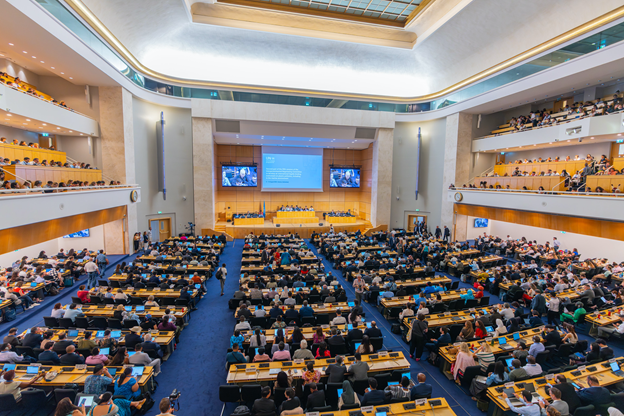
Geneva Plenary, 2022. Source (277)
When world leaders established the United Nations in 1945, there appeared to be little institutional space within the new organisation for environmental matters or the concept of sustainable development. Although the environment did not gain a dedicated political and global agenda until the creation of UNEP in 1972, environmental concerns were nonetheless addressed from the outset of the UN’s existence. The Food and Agriculture Organisation (FAO), also founded in 1945, incorporated environmental considerations into its work on food security and natural resource management. The International Whaling Commission (IWC), established in 1946 though not a UN body, represented the first attempt to regulate the exploitation of natural resources. Working in close cooperation with the UN from its inception, the IWC was also the first organisation to articulate the principle of safeguarding natural resources for future generations. Significantly, and influenced by the 1972 Stockholm Conference that led to the establishment of UNEP, the international community agreed in 1982 to adopt a moratorium on commercial whaling — a measure that remains in place today.
Further intergovernmental organisations addressing environmental concerns followed these modest yet significant beginnings of the immediate post–Second World War period. One long-standing area of focus is related to the oceans. The International Maritime Organisation (IMO), based in London, was founded in 1948, although it did not begin its operational work until 1959. Its mandate combines legal, normative, and environmental matters relating to maritime affairs. The World Meteorological Organisation (WMO), established in 1950, has from the outset included within its mandate atmospheric science, climatology, geophysics, and hydrology – all inherently environmental domains. Notably, it was WMO, together with UNEP, that established the IPCC in 1988.
It would therefore be inaccurate to suggest that the UN’s engagement with environmental issues began only with UNEP in 1972. One of the UN’s most ambitious early environmental initiatives was in fact the Man and the Biosphere Programme, developed throughout the 1960s and 1970s and administered by UNESCO in Paris. Indeed, a central objective of the 1972 Stockholm Conference was the development of a declaration on the human environment – a “document of basic principles.” The origins of this idea can be traced to a mid-1960s proposal by UNESCO that the Stockholm Conference prepare a “Universal Declaration on the Protection and Preservation of the Human Environment.”
The United Nations has now passed its eightieth anniversary, and UNEP its fiftieth. These decades reveal far more successes than may be apparent at first glance. This is not to suggest that the work is complete – far from it. As this Pocket Guide has shown, numerous agreements, programmes, policies, and tools have emerged from these sustained efforts. One often overlooked achievement of this collective work is the immense body of knowledge the world has accumulated over time. The 1970s are frequently referred to as the “conference decade”: the 1972 UN Conference on the Human Environment in Stockholm; the 1973 Conference on the New International Economic Order in New York; the first World Population Conference in Bucharest in 1974, followed later that year by the World Food Conference in Rome; the first World Conference on Women in Mexico City in 1975; and the 1976 Habitat Conference on human settlements in Vancouver. Critics dismissed this period as a “conference circus,” overlooking the fact that these global gatherings produced, for the first time in history, reliable and comprehensive assessments of the issues under discussion. With this newfound understanding, the international community was finally equipped to begin developing meaningful solutions to national and global challenges.
Environment and Sustainable Development Governance – Evolving and Challenging Processes
The Pocket Guide has had an overarching theme dealing with governance issues as they relate to the environment and sustainable development, and we have tried to show that governance for environment and sustainable development has evolved significantly over the past eight decades, yet critical challenges remain at multiple levels. As the global community strives to achieve the Sustainable Development Goals (SDGs) and respond to the triple planetary crisis, it is essential to reflect on the lessons learned, the persistent barriers, and embrace the strategies that yield the greatest impact. This Pocket Guide does not intend to analyse the dilemmas governments, including the UN, have to face when choosing their course of action. In doing so, they have to keep in mind that there are key considerations for national, subnational, and local governments, societal stakeholders, and even several options to governance approaches – some embracing all elements of democracy, others are less open. But as the Pocket Guide shows, there are tools developed through the UN that can aid in choosing the best option.
Challenges for National, Subnational, and Local Governments
Reports researched and published by the UN system clearly demonstrate that stakeholders face complex and often conflicting demands in implementing environmental and sustainable development policies. National authorities must integrate environmental objectives into economic planning, social policy, and infrastructure development, while coordinating with subnational and local actors to ensure effective implementation. Limited technical capacity, inadequate financial resources, and competing political priorities often constrain the ability of governments to respond decisively to environmental crises. But as the Pocket Guide shows, the UN family has developed and is developing a large response system to these challenges in order to promote globally agreed outcomes as well as assist those nations in need of expert help. We have tried to showcase this in this brief introduction to the global UN work on governance issues.
Subnational and local governments, meanwhile, are on the frontlines of climate adaptation, biodiversity conservation, and pollution control. They often encounter challenges in mobilising resources, engaging stakeholders, and navigating regulatory frameworks established at higher governance levels. Capacity gaps, lack of technical expertise, and insufficient coordination with national and regional authorities can also limit the effectiveness of local interventions, even when strong policy frameworks exist. Available to the authorities, ‘burdened’ by carrying out the agreements from the many UN conferences, are a host of capacity building tools developed by the UN, and personnel ready to provide this capacity building.
The Pocket Guide attempts to illustrate that effective governance requires mechanisms that bridge these levels, ensuring that policies are adaptable, context-sensitive, and enforceable. We have shown that multi-level coordination, inclusive planning processes, and targeted capacity building are crucial for aligning local action with national and global objectives, while maintaining accountability and transparency has been made possible through years of global and well-coordinated negotiations yielding results.
A Continuous Forum with a Responsive Agenda
Still, persistent and insistent work keeps the issues alive and brings results. One of the merits of the Major groups community and other civil society stakeholders is to keep issues alive and present on agendas. The UNEP’s history can document this. The work on a plastics convention is an example of this. There is ample proof to show that the plastic issue may have been dropped from the global environmental agenda, had it not been for the adamant work of non-state actors. Phasing out lead from petrol is another such example. NGOs raised the issue in the early 1970s, kept it on the agenda and by 1998, the UN-Habitat and UNEP were given the mandate to oversee the global implementation of phasing out lead. Non-government stakeholders provided the input, science provided the facts, governments agreed (finally) to the policy, and UNEP provided the forum for agenda setting, presentations of facts, deliberations and finally enactment.
Challenges for Societal Stakeholders
Civil society, the private sector, and community-based organisations play an essential role in shaping environmental agreements and sustainable development outcomes, yet they also face significant barriers. Resource constraints, often limited access to decision-making platforms, and varying capacities to engage with technical and policy processes can reduce their influence. Moreover, fragmented governance structures may hinder meaningful participation, especially for marginalised or underrepresented groups. UNEP’s plenaries have at times been blocked by member states unhappy with the participation of non-state stakeholders, and these conflicts have not always been easily resolved.
For advocacy groups and other stakeholder organisations, the challenge lies in balancing short-term campaigns with long-term systemic engagement. While some actors excel at raising awareness and influencing public opinion, others may struggle to sustain involvement in multi-stakeholder policy processes or co-production initiatives. Ensuring equitable access to governance mechanisms is key to leveraging the knowledge, expertise, and legitimacy that societal stakeholders bring to environmental decision-making. Again, while all this is a key element of governance in decision-making processes, it lies outside of the mandate of the Pocket Guide.
Fostering effective collaboration requires inclusive processes that value diverse perspectives, strengthen local ownership of solutions, and create feedback loops between decision-makers and stakeholders. Without such integration, efforts risk being top-down or externally imposed, undermining both legitimacy and sustainability. We have alluded to these issues in our overview of the partnership initiatives in the Pocket Guide.
The Need for Common but Differentiated Governance and Meta-Governance
Sustainable and environmental development governance must recognise that not all actors share the same capacities, responsibilities, or impacts. The principle of “common but differentiated responsibilities” was raised as one of the 27 Rio Principles back in 1992, and this principle is critical for addressing global challenges such as climate change, biodiversity loss, and pollution, ensuring that all actors contribute fairly according to their means and historical responsibilities.
Meta-governance—the coordination of governance systems themselves—is equally important. With overlapping institutions, initiatives, and regulatory frameworks at local, national, and international levels, effective meta-governance ensures coherence, avoids duplication, and aligns incentives across scales. It also provides mechanisms for monitoring, accountability, and adaptive management in a complex and rapidly changing global environment.
Through meta-governance, states, international organisations, and societal stakeholders can harmonise efforts, share lessons, and jointly respond to crises. This approach strengthens the global governance architecture, making it more resilient, flexible, and capable of delivering measurable, sustainable development outcomes. The Pocket Guide has illustrated throughout all its chapters the basics for meta-governance as they have emerged over the thirty years the guide covers.
What Has the Best Impact: Advocacy vs. Co-Production?
There is an ongoing debate about the relative effectiveness of advocacy versus co-production in sustainable and environmental development governance. Advocacy—through campaigns, lobbying, and awareness-raising—can influence political will, mobilise resources, and shape public opinion. It is particularly effective in catalysing urgent action on emerging environmental threats or in holding governments accountable.
Co-production, on the other hand, involves joint problem-solving between governments, Major Groups, and other stakeholder organisations. This approach integrates diverse knowledge systems, fosters innovation, and enhances ownership of solutions, often leading to more sustainable and context-appropriate outcomes. Evidence suggests that combining advocacy to build momentum with co-production to implement solutions achieves the greatest long-term impact. But it is a precondition that all involved actors have the willingness, the mindset and the skills needed to work together. For example, if a stakeholder group or business actor has developed the skills to lobby, it has to unlearn these partially and learn how to work on equal footing with people representing different interests.
Ultimately, governance strategies that are flexible, inclusive, and evidence-based tend to be the most effective. Balancing top-down guidance with bottom-up engagement and linking advocacy to co-production strengthens the legitimacy, resilience, and transformative potential of environmental and sustainable development governance.
What we have aimed to illustrate, among others, is that all these elements have played out and will be playing out at the UN and other conferences that deal with governance for the environment and sustainable development.
Will a Strong UNEP Contribute to Enhancing Governance?
The concept of a World Environment Organisation (WEO) emerged during the late 1990s to address some of the limitations of UNEP. UNEP has always struggled to secure consistent funding and assert comprehensive authority over multilateral environmental agreements (MEAs) and global environmental policy. Establishing a WEO with universal membership could perhaps provide a larger financial base and position the organisation at the top of the global environmental governance hierarchy. The idea of a World Environment Organisation (WEO) has been advanced by scholars and policy advocates seeking to strengthen international environmental governance. Proponents argue that UNEP’s mandate, governance structure, and financial base limit its ability to coordinate the fragmented landscape of multilateral environmental agreements (MEAs). A WEO—envisioned as a fully-fledged specialised agency with universal membership, stable funding, and stronger authority—has been proposed as one possible institutional reform to address these limitations and provide a more coherent and effective global environmental governance structure.
Some proposals entailed that the WEO would be modelled as a hybrid normative and operational body, similar to the World Health Organisation (WHO) and the Food and Agriculture Organisation (FAO), meeting annually, and supported by an executive body to prepare Council decisions. Its potential roles and mandate could include:
- Representing the authoritative global voice on environmental matters;
- Coordinating environmental policy across the UN system;
- Providing a common framework for implementing and monitoring MEAs, with a shared secretariat for all agreements and subsidiary committees for individual MEAs;
- Guiding the global environmental science agenda and offering technical support to developing countries for monitoring and reporting environmental trends; and
- Establishing norms and standards and delivering evidence-based policy advice.
The WEO idea gained momentum in the 1990s and became a focal point of discussion leading up to the 2002 World Summit on Sustainable Development (WSSD). In 1997, a Special Session of the UN General Assembly saw Germany’s Chancellor Helmut Kohl, Brazil’s President Fernando Henrique Cardoso, South Africa’s Deputy President Thabo Mbeki, and Singapore’s Prime Minister Goh Chok Tong issue a Declaration for a Global Initiative on Sustainable Development, calling for consideration of “the establishment of a global environmental umbrella organisation of the UN with UNEP as a major pillar.” The WSSD itself did not resolve the question of a WEO, and debate has continued through the first decades of the 21st century. Perhaps this could be an idea to pursue towards 2030, when the world is to take stock of its future.
There is Hope in the Decisions We Make
The Pocket Guide begins its overview in the 1990s, but the content is mindful of the more than 40 years of diligent work of the UN family on the environment that precedes the 1990s, and that provides the solid background for decisions made since the 1990s. To paraphrase the polymath and philosopher Sir Isaac Newton “If I have seen further, it is by standing on the shoulders of giants,” it could be said that “the solidity and relevance of the Triple Planetary Crisis and the 17 Sustainable Development Goals rest on the shoulders of the gigantic, accumulated knowledge by the UN over the years.”
The UN is in the middle of a reform process and working under the mantle of UN80. The Pocket Guide has shown that the UN is too rich to be dismantled in the way that some politicians would like to do. The UN 80 process enables us to look at some of the history of the UN Environment Programme, including sustainable development issues and how to make the UN system more “agile, integrated, and equipped to respond to today’s complex global challenges”. A historic lens is needed to understand what needs to be taken care of and what can be wisely changed, and it would be wise to see if elements of this history can be resurrected and a debate around them can be reenergized to accomplish the goals of the present reform process. And looking into the annals of UN history, it is evident that UN reform is not a single event responding to global politics, but a continuous process of adaptation and evolution.
In 2004, the Kenyan environmentalist, Wangari Maathai, was awarded the 2004 Nobel Peace Prize for her “contribution to sustainable development, democracy and peace.” Working often with UNEP and understanding the need to protect and defend the environment and sustainable development, she said: “When we plant trees, we plant the seeds of peace and seeds of hope.” In connection with the UN Summit of the Future, in September 2024, a strong postulation both reflecting Maathai’s sentiment and supporting the essence of the UN was expressed: “Without peace, there is no life; Without democracy, there is no freedom; Without nature, there is no future.”
The Pocket Guide has attempted to give you a small insight into the work of the UN on the environment and sustainable development. By now, it should be evident that what we have tried to do is to open the door to the vast and ongoing work of the United Nations in the area of environment and sustainable development. If we have managed to crack open this door, we hope that you have been inspired to open it fully, enter the room of environment and sustainable development, and become fully engaged.
References
277 United Nations Environment Programme. UNEP Photo Archive. https://www.flickr.com/photos/unep/54720494830/