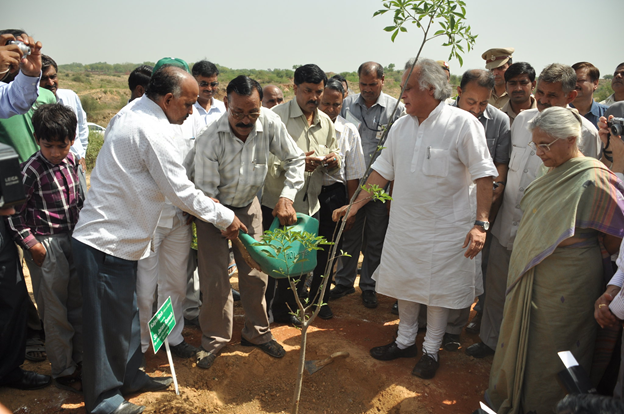
Tree planting ceremony in Jaunapur, 3 June 2011. Source (217)
In recent years, the global community has made significant strides in addressing the triple planetary crisis of climate change, biodiversity loss, and pollution through landmark agreements and collaborative scientific initiatives. These achievements reflect the growing commitment of nations to work together toward a sustainable future, guided by science, shared responsibility, and equitable action. The following examples highlight some of the most notable success stories shaping global environmental governance and driving progress toward a healthier planet.
Minamata Convention on Mercury
Adopted in 2013 and entered into force in 2017, the Minamata Convention on Mercury (218) is a global treaty designed to protect human health and the environment from the adverse effects of mercury. Named after the Japanese bay of Minamata, where industrial mercury poisoning caused severe illness and the death of approximately 2,000 people during nearly four decades in the mid-20th century, the convention represents a milestone in international chemical management and pollution prevention, and the resulting convention is a good example of fruitful and collaborative efforts between governments and civil society stakeholders.
The treaty controls the entire mercury life cycle, from mining and trade to product manufacturing, emissions, and waste disposal. It bans new mercury mines, phases out mercury-added products like thermometers and batteries, and restricts industrial processes using mercury. Countries must also develop national plans to reduce emissions from sources such as coal-fired power plants and artisanal gold mining, which are major contributors to global mercury pollution.
Through cooperation and technical assistance, the Minamata Convention supports developing countries in implementing cleaner technologies and monitoring systems. It embodies a model of environmental justice and global solidarity—acknowledging both the scientific urgency of chemical management and the human cost of inaction.
The Intergovernmental Science-Policy Panel on Chemicals, Waste, and Pollution
Recognising the growing threat of pollution and chemical waste, the Intergovernmental Science-Policy Panel on Chemicals, Waste, and Pollution (ISP-CWP) (219), established in June 2025, was proposed to strengthen the science-policy interface for these issues, similar to how the IPCC and IPBES serve climate and biodiversity. Formally established by the United Nations Environment Assembly (UNEA 6) (220) in 2024, the panel aims to provide policymakers with credible, comprehensive, and independent scientific assessments on pollution and chemicals to inform global action.
The panel will compile and analyse data on pollutants’ health and environmental impacts, evaluate policy effectiveness, and identify emerging risks. It will also help bridge gaps between governments, researchers, industry, and Major Groups, fostering shared accountability and evidence-based decision-making.
By establishing the ISP-CWP, the international community acknowledges pollution as one of the most urgent yet under-addressed dimensions of the triple planetary crisis. The panel is expected to become the authoritative voice on chemical and waste science—helping to guide coordinated, global responses to toxic pollution in the decades ahead.
The Kigali Amendment to the Montreal Protocol
Adopted in 2016, the Kigali Amendment (221) builds on the historic success of the Montreal Protocol (222), the world’s most effective environmental treaty for protecting the ozone layer. While the original protocol targeted ozone-depleting substances, the Kigali Amendment focuses on hydrofluorocarbons (HFCs) (223), potent greenhouse gases used in refrigeration and air conditioning. Though HFCs do not deplete the ozone layer, they have a global warming potential thousands of times greater than carbon dioxide.
The amendment requires countries to phase down HFC production and consumption by more than 80 per cent over the next 30 years. This shift is expected to prevent up to 0.4°C of global temperature rise by the end of the century—making it one of the most significant climate mitigation actions taken to date.
The Kigali Amendment also promotes the adoption of energy-efficient, climate-friendly cooling technologies and provides financial and technical support to developing nations through the Multilateral Fund. It exemplifies how global cooperation, backed by sound science and strong policy frameworks, can address both ozone protection and climate change simultaneously.
The Paris Climate Agreement
Adopted in 2015 under the United Nations Framework Convention on Climate Change (UNFCCC) (224), the Paris Agreement (225)represents a global commitment to limit global warming to well below 2°C (and preferably 1.5°C) above pre-industrial levels. It is the first legally binding climate treaty requiring all nations, developed and developing alike, to set and communicate their own climate action plans, known as Nationally Determined Contributions (NDCs) (226).
The agreement emphasises transparency, adaptation, and equity, recognising the differing capabilities and responsibilities of nations. Countries are encouraged to increase their ambition every five years, reflecting evolving science and technology. The Paris Agreement also mobilises finance and capacity-building support for developing countries, aiming to make low-carbon and climate-resilient development universally achievable.
Despite ongoing challenges in implementation, the Paris Agreement has reshaped the global policy landscape. It has catalysed national commitments, business innovation, and stakeholder action—making climate action a central pillar of sustainable development.
Nagoya Protocol on Access and Benefit-Sharing
Adopted in 2010 under the Convention on Biological Diversity (CBD) (227), the Nagoya Protocol (228)establishes a legal framework for the fair and equitable sharing of benefits arising from the use of genetic resources and associated traditional knowledge. Its goal is to ensure that countries and communities providing these resources are rightfully compensated and included in research and innovation that depends on their biodiversity.
The protocol requires users of genetic resources—such as pharmaceutical, agricultural, and biotechnology companies—to obtain prior informed consent and negotiate mutually agreed terms with provider countries or Indigenous peoples. This helps protect biodiversity-rich nations and Indigenous communities from exploitation while promoting conservation through equitable incentives.
By promoting trust, transparency, and fairness, the Nagoya Protocol strengthens global cooperation in biodiversity management. It bridges conservation and sustainable use with human rights and equity, ensuring that those who protect and steward biodiversity also share in its benefits.
Together, these landmark agreements and initiatives illustrate how international cooperation, scientific expertise, and equitable governance can deliver real progress on the triple planetary crisis. From curbing mercury and HFC emissions to safeguarding biodiversity and regulating chemical waste, each treaty demonstrates a shared global commitment to sustainability. While challenges remain, these successes provide a roadmap for future action—showing that with collaboration, transparency, and accountability, tangible environmental recovery is possible.
The Convention on International Trade in Endangered Species of Wild Fauna and Flora
Though not a UN convention, the Convention on International Trade in Endangered Species of Wild Fauna and Flora (CITES) (229) is a result of an initiative of IUCN – the International Union for the Conservation of Nature in 1963. The office of CITES is administered by UNEP in Geneva. CITES entered into force in 1975, and it aims to ensure that international trade (import/export) in specimens of animals and plants included under CITES does not threaten the survival of the species in the wild. It is one of the oldest conservation and sustainable use agreements in place and has 185 parties or member states. Although CITES is legally binding on the Parties, it does not take the place of national laws. CITES affords varying degrees of protection to nearly 41,000 species. It works closely with the UNCBD.
The WHO Framework Convention on Tobacco Control
In addition to chemical and waste management more broadly, targeted international efforts addressing specific pollution sources are emerging. For example, the FCTC (230) includes a dedicated article on environmental protection and recently adopted a decision to strengthen measures against environmental harm from tobacco products. This is particularly relevant given that cigarette butts are the most littered item on the planet and one of the most toxic forms of daily consumer waste, while the growing prevalence of single-use e-cigarettes adds a new environmental challenge. Integrating such source-specific evidence into broader assessments like those conducted by ISP-CWP can enhance the effectiveness of global pollution reduction strategies and support science-informed policy interventions. FCTC includes a dedicated article on environmental protection and recently adopted a decision to strengthen measures against environmental harm from tobacco products. This is particularly relevant given that cigarette butts are the most littered item on the planet and one of the most toxic forms of daily consumer waste, while the growing prevalence of single-use e-cigarettes adds a new environmental challenge. Integrating such source-specific evidence into broader assessments like those conducted by ISP-CWP can enhance the effectiveness of global pollution reduction strategies and support science-informed policy interventions.
217 United Nations Environment Programme. UNEP Photo Gallery. https://www.flickr.com/photos/unep/5803799494/in/album-72157626772796685
218 Minamata Convention on Mercury. Minamata Convention on Mercury. https://minamataconvention.org/en
219 United Nations Environment Programme. Inter-Secretariat Programme for Chemicals Management. https://www.unep.org/isp-cwp
220United Nations Environment Programme. United Nations Environment Assembly 6. https://www.unep.org/environmentassembly/unea6
221 United Nations Treaty Collection. Paris Agreement. https://treaties.un.org/Pages/ViewDetails.aspx?src=IND&mtdsg_no=XXVII-2-f&chapter=27&clang=_en
222 United Nations Environment Programme. The Montreal Protocol. https://www.unep.org/ozonaction/who-we-are/about-montreal-protocol
223 Climate and Clean Air Coalition. Hydrofluorocarbons. https://www.ccacoalition.org/short-lived-climate-pollutants/hydrofluorocarbons-hfcs
224 United Nations Framework Convention on Climate Change. United Nations Framework Convention on Climate Change. https://unfccc.int/process-and-meetings/united-nations-framework-convention-on-climate-change
225 United Nations Framework Convention on Climate Change. The Paris Agreement. https://unfccc.int/process-and-meetings/the-paris-agreement
226 United Nations Framework Convention on Climate Change. Nationally Determined Contributions. https://unfccc.int/process-and-meetings/the-paris-agreement/nationally-determined-contributions-ndcs
227 Convention on Biological Diversity. Convention on Biological Diversity. https://www.cbd.int/
228 Convention on Biological Diversity. Access and Benefit-Sharing. https://www.cbd.int/abs/default.shtml
229 Convention on International Trade in Endangered Species of Wild Fauna and Flora. Text of the Convention. https://cites.org/eng/disc/text.php
230 World Health Organization Framework Convention on Tobacco Control. “4.5 Trillion Cigarette Butts Are Equal to 1.69 Billion Pounds of Toxic Trash.” WHO FCTC, June 6, 2024. https://fctc.who.int/newsroom/spotlight/environment/4.5-trillion-cigarette-butts-are-equal-to-1.69-billion-pounds-of-toxic-trash